Nevada has had two organizations called the Nevada Brothel Association, separated by years and built under very different circumstances. The first emerged in 1985, when the AIDS crisis and renewed political pressure forced brothel owners who normally operated independently to find a way to speak collectively. The second appeared after Dennis Hof’s death in 2018, during another period when legal prostitution faced organized political opposition.
The first developed over time as an owners’ association with leadership extending across independently operated brothels. George Flint, a longtime Nevada lobbyist, became its enduring political representative, but the surviving record also shows brothel owners from different companies serving in leadership positions. The revived organization was structured differently from the beginning: it registered as a political action committee and was created by people from Hof’s brothel and political network before reaching outward to other operators. Those differences are easier to see in the historical record than in the shared name.
The Original Nevada Brothel Association
AIDS Forces Nevada’s Brothel Owners to Organize
The best-supported published history places the formation of the Nevada Brothel Association in the spring of 1985. Sociologists Barbara Brents, Crystal Jackson and Kathryn Hausbeck write in The State of Sex that Nevada brothel owners came together that year and decided to form an association. Joe Conforte, the powerful owner of the Mustang Ranch, encouraged the effort and asked George Flint, an established Nevada lobbyist, to help organize it. By 1986, 22 owners had joined, and Flint was preparing to represent them during the 1987 Legislature.
AIDS made cooperation unusually urgent. Nevada’s brothels were legal only in counties that chose to license them, and the emerging epidemic gave opponents a powerful new argument for shutting the system down. The owners also had a practical problem: health policy was becoming a statewide issue even though brothel licensing remained local. An industry built around fiercely independent businesses suddenly needed a common response.
Nevada had already begun requiring HIV testing of licensed brothel workers before the Legislature took up Assembly Bill 550 in 1987. The law that passed that June went further. Among its provisions, it made it a felony for someone to continue working as a prostitute in a licensed house after testing positive for HIV and receiving notice of the result, and it created potential civil liability for an owner or operator who knowingly continued employing a worker who had tested positive. Nevada’s 1987 statutes document those provisions.

Russell Reade Emerges as an Early NBA Leader
The association’s early history is important because it shows that the organization was not simply George Flint using a statewide title. Russell Reade, an owner and manager of the Chicken Ranch in Nye County, emerged as one of its first identifiable owner-leaders. On April 23, 1987, the official legislative history of AB 550 identified Reade as the Chicken Ranch’s owner-manager and as a representative of the “Nevada Association of Brothels.” He testified in support of the AIDS legislation and described the health practices being used by licensed houses.
By January 1988, contemporary reporting was more explicit. United Press International identified Reade as president of the Nevada Brothel Association when the State Board of Health adopted a mandatory-condom regulation. Reade said the Chicken Ranch had already required condoms voluntarily and that the association supported the statewide rule. By June 1990, UPI was identifying him as a past president. That sequence – president-elect in the association’s early period, legislative representative in 1987, president by 1988 and past president by 1990 – is unusually strong evidence of genuine owner leadership separate from Flint.
George Flint Becomes the Industry’s Permanent Political Voice
Flint’s role was different. He was the professional who stayed. Over the following decades he became the industry’s longtime political representative, appearing repeatedly before lawmakers, monitoring bills and maintaining relationships in Carson City. By 1992, medical literature discussing outside research in Nevada identified him as executive director of the Nevada Brothel Association. A later medical-journal account describes how Flint helped researcher Alexa Albert gain unusually broad access to the Mustang Ranch that year.
That episode shows a side of Flint’s job that is easy to miss if his career is reduced to legislative testimony. Albert had spent years trying to gain access to a legal brothel for research. According to the published account, Flint invited her to Nevada and arranged for her to spend time at the Mustang Ranch, where she was eventually allowed around-the-clock access. The research became the basis for her book Brothel: The Mustang Ranch and Its Women. Flint was functioning not just as a lobbyist but as a gatekeeper between a guarded industry and an outside researcher.
The NBA Puts Money Behind Public Health Research
The association also put money behind research of its own. In 1990, UPI reported that researchers had examined seven years of medical and employment records involving 246 women who had worked at the Chicken Ranch. The work was supported by a $21,000 grant from the Nevada Brothel Association. The researchers reported no HIV cases in the study group and low rates of sexually transmitted disease.
The study did not prove that every Nevada brothel was disease-free, nor should it be used that way. What it does establish is that the NBA had accumulated enough collective resources to finance outside public-health research at a moment when the industry’s survival was closely tied to whether Nevada could defend its regulatory system with evidence rather than reassurance.
A Broad Association, But Never a Fully Unified Industry
The original NBA appears to have developed broad participation, but Nevada’s brothel owners never moved in lockstep. That distinction becomes important whenever old newspaper stories say Flint “represented” every brothel or nearly every brothel in the state. Representation, formal membership, financial support and organizational control are not the same thing.
By 2005, Flint was telling the Reno Gazette-Journal that the Nevada Brothel Owners Association represented about 18 of Nevada’s 27 legal brothels and roughly 90 percent of the industry’s business. Those were Flint’s own figures, not an audited membership list, but they show that he was describing a substantial coalition while acknowledging that other houses remained outside it.
The historical gaps are real. UNLV Special Collections holds Nevada Brothel Association folders covering approximately 1990 to 1999 in the Kathy Eastland Papers. Those materials are not currently available online, and Brothel Nevada has not yet reviewed the physical files. They may eventually clarify membership, dues, officer changes and internal governance that cannot be reconstructed confidently from the public record alone.
Geoff Arnold and a Second Generation of Owner Leadership
The clearest later example of owner leadership is Geoff Arnold. In January 2005, the Northern Nevada Business Weekly identified Arnold as president of the Nevada Brothel Association when he appeared before Churchill County commissioners to discuss proposed changes to their brothel ordinance. The article said Arnold owned brothels in Wells and Battle Mountain. Academic researchers likewise described Arnold as the head of the association while separately describing Flint as its lobbyist.
That separation of roles is useful. Flint may have been the person lawmakers and reporters saw most often, but Reade and Arnold show an organization in which an owner could occupy the presidency while a professional lobbyist handled much of the day-to-day political work. It is one of the strongest differences between the first association and the surviving governance record of the second.
The Nevada Brothel Association or the Nevada Brothel Owners Association?
The historical record becomes confusing in the 2000s because the organization appears under two closely related names: Nevada Brothel Association and Nevada Brothel Owners Association. Contemporary reporting could call Arnold president of the Nevada Brothel Association while official legislative records from the same period identified Flint as president of the Nevada Brothel Owners Association.
The inconsistency is not confined to newspaper shorthand. During a March 30, 2005 hearing, the official legislative history of AB 250 identifies “George Flint, President, Nevada Brothel Owners’ Association.” Two weeks later, Assembly committee minutes again identify Flint as president of the Nevada Brothel Owners Association. At roughly the same time, Arnold was still being described publicly as president of the Nevada Brothel Association.
The available records do not fully explain the overlap. The two names may have been used interchangeably, may have reflected different formal or public-facing identities, or may simply have been applied inconsistently by participants and reporters. There is not enough evidence to choose among those possibilities, and the article does not treat them as proven separate organizations.
Flint’s Value Was Often in the Bills That Were Not About Brothels
Some of the best evidence of what the old association actually did comes from legislation that was not primarily about prostitution. In the March 2005 massage-therapy hearing, Flint explained that statewide massage regulation had concerned the brothel association for years because broad language could inadvertently place licensed brothels under a new massage-regulatory system. He supported the measure once licensed brothel activity was expressly exempted. The legislative record preserves that exchange.
That kind of work was less visible than a dramatic fight over whether brothels should remain legal, but it was exactly the sort of problem a permanent trade-association lobbyist was positioned to catch. The value was often preventive: read a bill that appeared to be about another industry, recognize how a definition might reach brothels, and get the language corrected before it became law.

Dennis Hof Takes a Different Approach
By the middle of the 2000s, Dennis Hof had become one of Nevada’s most nationally recognizable brothel owners. HBO’s Cathouse had turned the Moonlite BunnyRanch into a national media brand, and Hof was increasingly willing to pursue his own political positions rather than simply follow the association’s consensus.
The 2005 tax fight is a clear example. The Washington Post identified Geoff Arnold as president of the Nevada Brothel Association and George Flint as its lobbyist while reporting that Hof opposed the proposed state brothel tax. Hof argued that brothels were already paying their fair share and should not have to accept a new tax merely to gain political legitimacy. The disagreement establishes a public split over policy; it does not, by itself, establish Hof’s formal membership status at that exact moment.
The separation was even clearer in 2009. Official Senate Taxation minutes list Flint for the Nevada Brothel Owners Association while Hof appeared separately as owner of the Moonlite Bunny Ranch and Love Ranch. Both were speaking about the same industry, but they were not appearing as a single delegation.
The Original Association Begins to Fade
The old association did not simply vanish at the end of the 2000s. In Nevada’s 2010 special session, Flint was still appearing for the Nevada Brothel Owners Association, and the Senate Journal records him saying that his board had unanimously authorized him to renew the industry’s proposal for a $5-per-transaction tax. That is unusually direct evidence that some formal governance still existed.
By 2011, however, Nevada’s official lobbyist records were using a different client name: Select Legal Brothels of Nevada. The same name appears again in the 2013 employer list. The records do not tell us whether this was a formal successor organization, a narrower consortium of Flint’s remaining clients or simply a different lobbying designation, so the safest conclusion is that the traditional association structure had become less visible even while Flint continued representing brothel interests.
The final shift is documented in 2015. Nevada’s official paid-lobbyist list shows Flint representing Dennis Hof Enterprises directly rather than a statewide brothel association. That same spring, Flint suffered a heart attack and retired. The Los Angeles Times reported that the political-contribution budget associated with the brothel owners’ group had fallen from roughly $100,000 a year to about $20,000 as the industry contracted. Flint’s retirement did not necessarily mark a formal dissolution on a specific date, but it removed the political professional who had carried the industry’s collective presence in Carson City for three decades.

The Revived Nevada Brothel Association
A Brothel Fight, Hof’s Death and a New Association
By 2018, Nevada’s brothel industry had gone several years without anything resembling the old statewide owners’ organization. Flint was retired, and Hof had become the industry’s most visible political and media figure. Hof was also running as a Republican for Nevada Assembly District 36.
That year legal brothels became an election issue in Lyon County. Voters were asked whether the county should rescind its brothel ordinance. The four licensed brothels in the county were Hof properties in Mound House. The proposal was decisively rejected: final reporting put the vote at 16,643 against rescinding the ordinance and 4,031 in favor. Northern Nevada Business Weekly reported the result as part of its later review of the industry’s political fight.
Hof died on October 16, 2018, less than three weeks before Election Day. The campaign continued without him. Alice Little and Ruby Rae, two licensed sex workers from Hof’s brothels, had already become visible defenders of the Lyon County houses, while Chuck Muth, Hof’s campaign manager, was involved in the political effort.
The Nevada Brothel Association PAC filed with the Nevada Secretary of State in November. Associated Press identified Suzette Cole, who managed Hof’s four Lyon County brothels, as director and Muth as spokesman. Muth said the Lyon County fight had helped spur the group’s formation and that the new association intended to oppose the anticipated statewide prohibition effort. AP also reported that the organization planned to reach out to other brothel owners and invite them to join.
A January 2019 Pahrump Valley Times report gave more detail, attributing the launch to a Hof-team announcement. It said the PAC was formed by Cole, Little and Rae, with Muth serving as registered agent and spokesman, and described the founding group as coming from Hof’s four Lyon County houses: Bunny Ranch, Kit Kat Ranch, Love Ranch and Sagebrush Ranch. The announcement said other operators would be approached before the Legislature convened.
“We Don’t Need Dennis to Represent Us Anymore”
Little’s own explanation captured what the new organization was trying to become. In a January 2019 interview with The Record-Courier, she said: “Dennis did Dennis, and we’re not trying to be Dennis. Something new is going to happen. The women who work at the brothels are going to make something new … and we don’t need Dennis to represent us anymore.” The article said Little viewed her participation in the revived Nevada Brothel Association as part of that effort.
The statement marked a real change from the old model. The first NBA had been an owners’ association whose most durable public representative was a professional lobbyist. The revived group put sex workers themselves much closer to the front of its public advocacy, a shift that became particularly visible when Little and Rae appeared before the Legislature as NBA ambassadors.
Did the New NBA Really Represent 21 Brothels?
Contemporary reporting almost immediately produced a membership puzzle. A January 16, 2019 article said the new NBA “represents 21 legal brothels across seven counties.” But the same article said the organization intended to seek owners to join, and it quoted Muth saying, “We haven’t spoken with the other brothel operations yet.” The article itself therefore makes it impossible to treat “21 brothels” as a reliable formal-membership count.
The same evidentiary rule applies to both generations of the NBA. A public claim that an organization represents a brothel is not proof that the owner formally joined it. Membership is not proof of financial support, and financial support is not proof of organizational control. For the revived NBA, the public record clearly establishes a Hof-centered founding group and later cooperation with independent houses. It does not provide a complete dues-paying membership or voting roster.
The New NBA Goes to Carson City
The revived association did become an identifiable participant in the 2019 Legislature. On March 28, the official Assembly minutes on ACR 6 identify Alice Little and Ruby Rae as Nevada Brothel Association ambassadors. Rae told the committee that she would read a statement from Suzette Cole, identified as president of the Nevada Brothel Association.
The association supported studying Nevada’s legal brothel system while urging lawmakers to consider issues such as illegal sex work, geographic restrictions, advertising rules and the composition of the study committee. ACR 6 ultimately passed as a legislative study resolution. The adopted resolution provides a formal record of the Legislature’s decision to examine the issue.
Other Brothels Still Spoke for Themselves
The existence of a statewide-sounding association did not mean every brothel began speaking through it. Independent operators continued developing their own positions and advocacy efforts. Bella Cummins, owner of the Hacienda Ranch in Wells, created the Onesta Foundation and publicly discussed her own goals for regulation, research and worker treatment in early 2019. Northern Nevada Business Weekly reported on that separate effort while the revived NBA was getting started.
The legislative record also shows individual houses presenting their own voices. Sheri’s Ranch front manager and madam Dena Duff submitted a written statement to the Legislature in her capacity at Sheri’s; the official exhibit identifies her title and role. Mustang owner Lance Gilman likewise communicated his own position during the ACR 6 debate. Separate advocacy does not prove that a house was or was not an NBA member, but it does show that the revived association never became the only channel through which Nevada brothel operators addressed government.
COVID Forces Brothels Into Closer Cooperation
The strongest evidence of the revived NBA doing genuine multi-owner coordination came during the COVID-19 shutdown. Nevada ordered brothels closed in March 2020, and they remained shuttered far longer than many other businesses. As the industry argued for a path to reopening, the association published a common set of health and safety measures.
The NBA’s published protocol said the measures had been adopted by eight brothels: Bunny Ranch, Kit Kat Ranch, Sagebrush Ranch and Love Ranch in Lyon County, plus Mona’s Ranch, Inez’s D&D, Desert Rose and the Desert Club. The four latter houses were independently operated outside Hof’s former company. Whatever their formal membership status, those businesses had agreed to a shared operational framework published through the association.
Other houses also acted independently. The Nevada Independent reported separate efforts by Mustang Ranch and Chicken Ranch representatives to persuade state officials to allow brothels to reopen. The picture is therefore more complicated than either “the NBA represented everyone” or “the NBA only represented the former Hof houses.” It coordinated some statewide activity while independent operators continued to speak and act on their own.

Alice Little Takes the Governor to Court
In October 2020, Alice Little took a much more aggressive route. She sued Gov. Steve Sisolak, asking a court either to allow Nevada’s licensed brothels to reopen or to permit legal sex workers to work from private homes or other locations outside the licensed houses. The Nevada Independent reported that the lawsuit challenged a shutdown that by then had lasted for months.
In January 2021, District Judge Leon Aberasturi denied Little’s request for a preliminary injunction. The court noted that Little was an independent contractor rather than a brothel owner and that no brothel owners had testified about the effect of the governor’s directives on their businesses. Little told The Nevada Independent that she had spent more than $50,000 pursuing the case while out of work and said some owners had been willing to join as long as she continued financing the litigation.
Suzette Cole took a different position. Cole was running the former Hof brothels and serving as president of the Nevada Brothel Association. When asked about the reopening effort, she told The Nevada Independent that she had “no intention of joining” and that the brothels would reopen when the governor allowed them to.
Little had helped form the association, represented it publicly and appeared before lawmakers as an NBA ambassador. Her lawsuit, however, appears to have developed largely as her own effort rather than as a coordinated NBA strategy. It also went considerably beyond simply asking Nevada to reopen the brothels, seeking as an alternative to allow licensed sex workers to work from homes or other private locations. Cole pursued a different strategy. The episode shows two prominent figures in the same association taking very different approaches during the COVID shutdown.
When Nevada’s brothels were finally permitted to reopen on May 1, 2021, Little did not return to the Bunny Ranch. She resumed legal sex work at the independently operated Chicken Ranch in Nye County, a move reported by The Nevada Independent. There is no evidence establishing that Cole’s position on the lawsuit caused Little to leave the Bunny Ranch, and the sequence should not be presented that way. Little’s move nevertheless belongs in the history of this period.
The NBA Begins to Recede From View
The association’s visible public activity declined after the brothels reopened. Its website’s publishing activity slowed sharply, and by May 2022 there was a more concrete sign of reduced engagement. Minutes of Nevada’s Advisory Task Force on HIV Exposure Modernization state that the Nevada Brothel Association had been contacted but had not responded. The state meeting minutes support that narrow conclusion; they do not establish that the organization had ceased to exist.
The distinction became more important with time. Chuck Muth continued to be publicly associated with the NBA after its most active 2019-2021 period. In January 2026, for example, an author note on a Nevada News & Views column identified him as a government affairs advisor for the Nevada Brothel Association. That shows continued use of the association’s identity, but it does not establish that the PAC had been reactivated or that a functioning statewide membership organization remained behind the name.
The PAC Was Still Registered in 2024
A Nevada Secretary of State annual registration obtained while researching this article shows that the Nevada Brothel Association was still renewing its PAC registration in May 2024. The filing lists the committee as the Nevada Brothel Association, gives a Carson City mailing address and identifies Chuck Muth as registered agent.
Suzette Cole is listed as director and is the only officer disclosed on the 2024 registration form. Three additional officer spaces are blank, as is the section for affiliated organizations. Those entries have limits: a PAC registration is not a membership roster, and Cole being the only disclosed officer does not establish that she was the only person involved in association decisions.
Nevada’s campaign-finance search system currently lists the Nevada Brothel Association PAC as inactive. The publicly available records reviewed for this article do not establish precisely when that status took effect or why. Brothel Nevada has not yet requested the association’s complete registration history from the Secretary of State, so “inactive” should not be converted into “dissolved” or a specific date of closure.
Two Associations, Two Different Models
The two versions of the Nevada Brothel Association were created in response to very different crises, but both were attempts to solve the same basic problem: how to give a small, scattered industry a stronger political voice. The first developed into an owners’ association with documented leadership from independently operated brothels and a permanent professional lobbyist in George Flint. The second was created after Dennis Hof’s death by people from his brothel and political network and later worked with operators around the state.
The difference is easiest to see in the surviving record of who actually led them. The original association had identifiable owner-presidents including Russell Reade of the Chicken Ranch and Geoff Arnold, who owned brothels in Wells and Battle Mountain. The revived NBA participated in legislative advocacy, gave sex workers a much more prominent public role and coordinated with independent houses, particularly during COVID. But the records reviewed for this article do not show the same kind of shared owner leadership. Its 2024 PAC registration listed Suzette Cole as the only disclosed officer and Chuck Muth as registered agent.
Alice Little’s COVID lawsuit offers another glimpse into how the second organization functioned. Little had helped form and publicly represent the NBA, yet she pursued a major legal challenge to the shutdown largely on her own. Her lawsuit went beyond simply asking Nevada to reopen brothels; it also sought permission for licensed sex workers to work outside them, a major departure from the state’s existing system. Cole pursued a different strategy and did not join the reopening effort. The significance is less that the NBA failed to support Little than that one of its most prominent figures could pursue such a consequential strategy outside an apparent coordinated association effort. The episode suggests an organization capable of bringing people together, but not necessarily one directing them through a unified political strategy.
There are still gaps in the history. Brothel Nevada has not yet reviewed the Nevada Brothel Association files held by UNLV Special Collections or requested the revived PAC’s complete registration history from the Secretary of State. Those records may eventually fill in details that are missing today. What the available record already shows is that the two organizations shared a name, but they did not develop into the same kind of association.
Photo Credits
Dennis Hof at AVN Awards 2006, photo by jerone2, via Wikimedia Commons/Flickr, CC BY-SA 2.0.
Chicken Ranch, photo by Brian Redbeard, via Wikimedia Commons, CC BY-SA 3.0.
Moonlite BunnyRanch roadside sign, photo by Drew Jacksich, via Wikimedia Commons/Flickr, CC BY-SA 2.0.
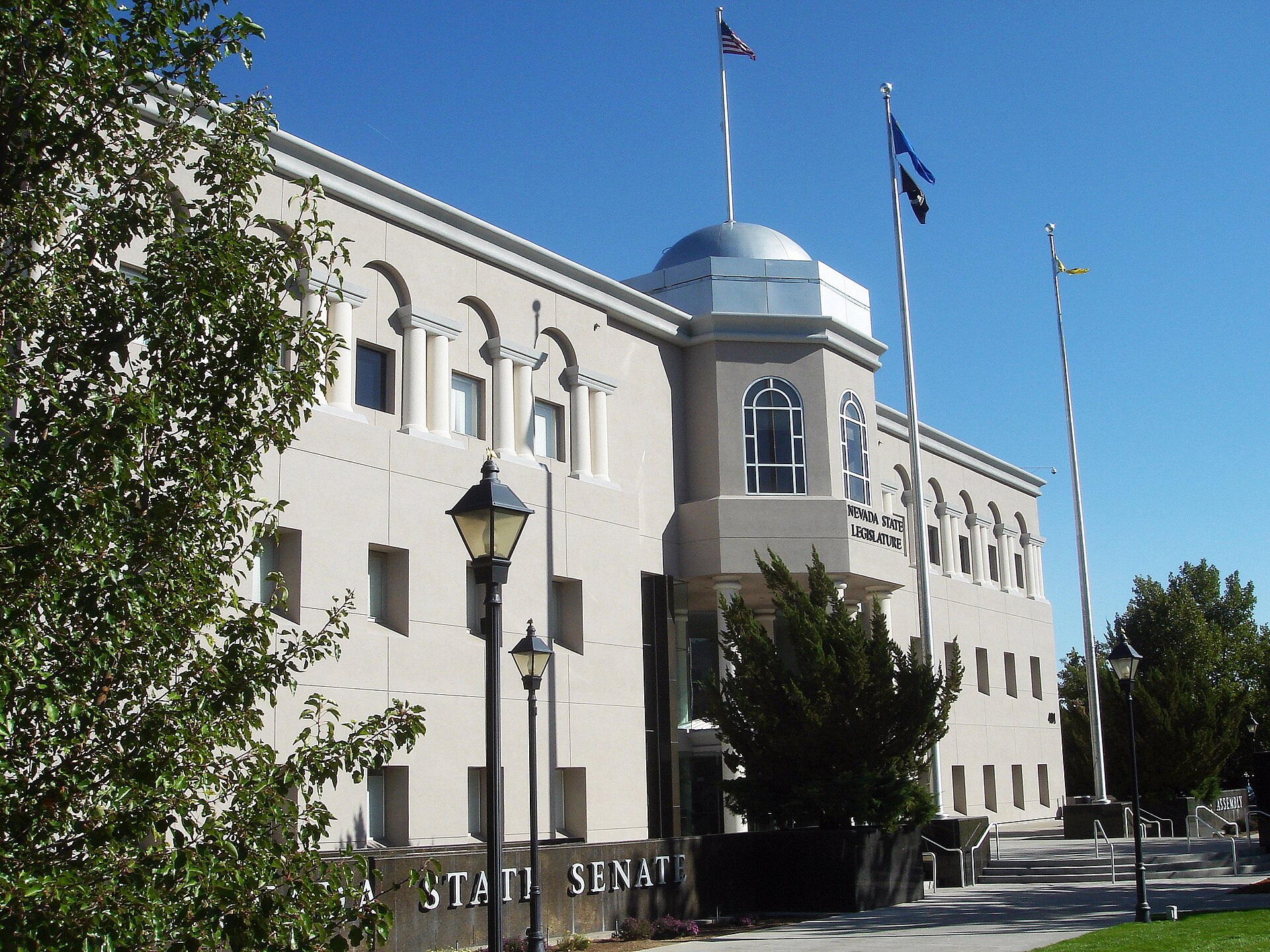
Nevada Legislature Building, photo by Dave Parker, via Wikimedia Commons, CC BY 3.0.
Photo of Alice Little used with permission from Little
Leave a Reply