The Bunny Ranch is for sale for $33.9 million, which naturally raises one question: who has enough money to buy it? But after looking at the history of Nevada’s best-known brothels and the people who have owned them, wealth starts to look like only the first qualification.
The Bunny Ranch Legacy Portfolio is being offered as a single transaction that includes 11 real estate parcels, the Moonlite Bunny Ranch, Sagebrush Ranch and Love Ranch operating facilities, along with equipment, vehicles, trade names, websites and other digital assets. The sellers are offering up to a year of transition and training support, and longtime Bunny Ranch executive Suzette Cole has said she wants to pass the businesses to someone with a “new and fresh approach.”
There are certainly individuals and companies wealthy enough to consider a transaction of this size. A much smaller group would be willing to put that money into a legal brothel business and accept everything that comes with publicly owning one of the most recognizable brands in Nevada’s legal sex industry. That combination of wealth, independence and, frankly, brass balls is where the pool of realistic buyers starts getting interesting.
Moonlite BunnyRanch, Mound House, Nevada, 2022. Photo: Carol M. Highsmith. Carol M. Highsmith’s America Project, Library of Congress, Prints and Photographs Division.
Having the Money Is Only the Beginning
Nevada has already seen what can happen when a seemingly capable buyer wants a major brothel but can’t quite get the money across the finish line. In August 1985, Strong Point Inc., a small publicly traded real estate investment company based in Southern California, agreed to buy the Mustang Ranch from Joe and Sally Conforte for $18 million. Some reports at the time went so far as to announce that the Mustang had been sold, although Strong Point was still trying to raise the money and the deal remained in escrow.
The effort dragged on for nearly two years. By January 1987, Strong Point was still trying to borrow the money needed to complete the purchase. Mustang attorney Peter Perry told the Los Angeles Times that many normal lending sources weren’t available for a bordello and that a lot of banks simply didn’t want to get involved. Strong Point finally abandoned the $18 million acquisition in July 1987, after 23 months of trying to finance it.
That history is worth remembering when looking at the Bunny Ranch sale. A prospective buyer can have extraordinary financial resources while much of that capital is tied to business partners, investors, family interests, trusts or lenders who may have no interest in being associated with a brothel. Someone with less wealth on paper but greater control over it could be in a much better position to actually make the purchase.
Fame and Infamy Come with the Deal
The Bunny Ranch portfolio comes with something that can’t be measured in acreage, buildings or equipment: a name with national recognition. But before any buyer can decide what that recognition is worth, there is a more personal question. Are you comfortable having your name associated with a licensed house of prostitution? Is your spouse? Your family?
Dennis Hof certainly was. Instead of simply living with the stigma, he figured out how to weaponize it. Hof knew the Moonlite Ranch long before he bought it in 1992, and after taking ownership he increasingly turned his identity as a brothel owner into part of the Bunny Ranch marketing strategy. Television, radio, celebrity appearances, political fights and controversy all became opportunities for publicity. By 2015, Hof was openly saying that he was always looking for another angle to keep both his own name and the Bunny Ranch name in the national conversation.
Legal brothels occasionally attract outsized media attention, and the stories that travel furthest tend to involve controversy, scandal or allegations rather than the ordinary day-to-day operation of the business. In 2025, A&E aired the six-part Secrets of the Bunny Ranch, which focused heavily on allegations made by former workers about Hof. A year later, Netflix revisited Lamar Odom’s near-fatal 2015 medical emergency at Hof’s Love Ranch South in Untold: The Death & Life of Lamar Odom. Odom has since alleged that he was drugged and that Hof tried to kill him. Those accusations remain allegations, but they have become part of the public history surrounding Hof and his brothel empire.
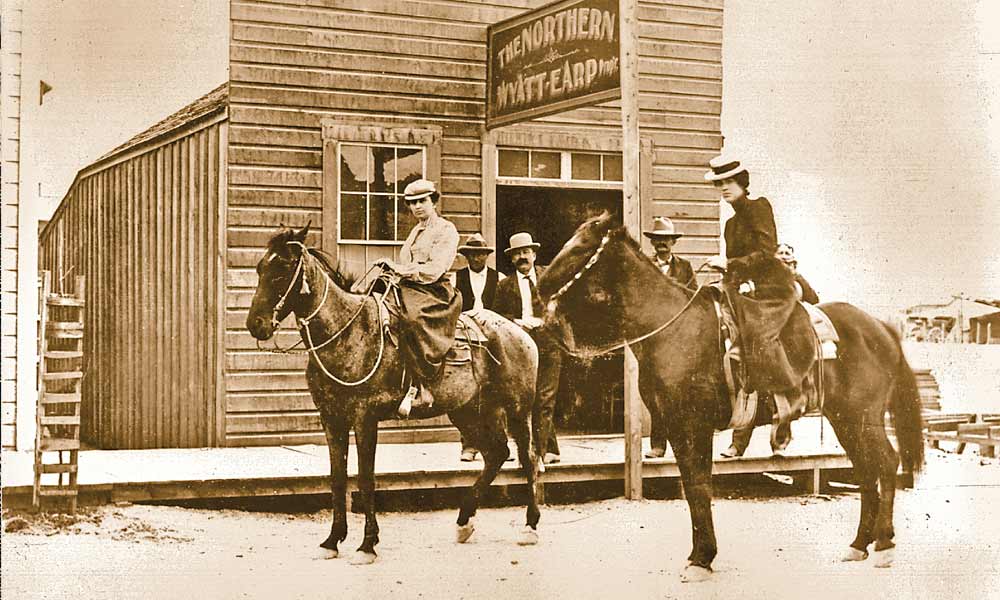
The Mustang Ranch provides a remarkably close Nevada precedent. By the time Joe Conforte was gone, the Mustang name carried decades of notoriety involving criminal convictions, tax battles, political controversy and eventual federal seizure of the brothel. Yet when Lance Gilman acquired the old Mustang buildings and trademark in 2003, he already owned the newer Wild Horse brothel. KNPR later made the distinction almost perfectly: the Wild Horse was newer, cleaner and more professional, but the Mustang possessed something it didn’t have: “Notoriety.” Gilman saw enough value in that recognition to preserve and market the internationally known Mustang name.
Gilman also showed that openly owning a brothel didn’t have to consume the rest of a successful business career. He maintained substantial interests in real estate, development and other mainstream businesses while making Nevada’s unusual approach to legalized prostitution part of a broader Wild West businessman identity. When he ran for Storey County commissioner in 2012, he did so openly as the Mustang owner. He won with 62 percent of the vote and told the Los Angeles Times that he wasn’t ashamed of owning it.
Gilman didn’t need the public to forget Joe Conforte in order to make use of the Mustang Ranch name. He needed the public to recognize the name while understanding that the business was now being operated by someone else. A Bunny Ranch buyer would face something similar. The HBO years, Dennis Hof, the controversies and the documentaries won’t disappear when the deed changes hands, but a new owner doesn’t inherit personal responsibility for everything that came before.
For a buyer who understands branding, that can be an unusual opportunity. Notoriety can be baggage, but in a business where public recognition is extraordinarily difficult to create, it can also be raw material. The challenge is knowing what to preserve, what to distance the business from and what kind of reputation to build next.
Moonlite BunnyRanch, Mound House, Nevada, 2006. Photo by Joseph Conrad. Licensed under CC BY-SA 2.0 via Wikimedia Commons.
The Expertise Is Unique Too
A buyer can clear every hurdle we’ve discussed so far and still know very little about running a Nevada brothel. The industry is a very small corner of the much larger adult entertainment economy, highly specialized and unlike almost any other business a prospective owner is likely to have run before. A successful entrepreneur can bring accountants, attorneys, hotel managers, security professionals and marketing people to the table and still discover that very few of them have any practical experience running a legal Nevada brothel.
The regulations are the easiest part to see from the outside. Brothels operate under privileged local licenses, and mistakes involving worker licensing, health requirements, testing protocols or other county rules can have consequences far beyond the ordinary problems a hotel or nightclub might face. Much of the expertise required to run a successful brothel is harder to see.
A brothel may be working with dozens of independent sex workers, some returning after years in the business and others arriving for their first tour. Like any other group of human beings, they come to the house with different goals, obligations and life experience. One woman may be finishing college and paying off student loans, another may be supporting a family, while someone else may be raising money for a future business or treating sex work itself as her entrepreneurial career. Management has to cultivate an environment where people arriving from very different backgrounds can learn the business, work together and have a fair opportunity to succeed.
That requires a kind of experience that isn’t easily imported from another industry. A woman arriving for her first tour may need to learn the house, the negotiation process, customer flow, safety practices and the practical realities of working in a brothel from the ground up. A veteran returning for her twentieth tour may arrive with an established clientele, a recognizable personal brand and a highly developed way of conducting her business. Meanwhile, the lineup continues changing as women arrive and leave, and the house has to support a constantly shifting group of independent contractors without treating them as though they were interchangeable.
Even marketing requires knowledge that doesn’t transfer neatly from another industry. Nevada brothels operate in a narrow legal market with unusual advertising constraints, while conventionally useful tools like social media platforms impose their own restrictions on adult content. The relationship between a house, its independently marketed courtesans, its website, search traffic, forums, publicity and returning customers has developed over decades. There simply aren’t many people who have spent years learning how all of those pieces work together.
That makes the sellers’ offer of up to a year of transition and training support far more important than it might first appear. For a conventional business acquisition, a year of training can sound like a generous extra. Here it may be central to making the transfer work. A new owner can buy the buildings, the Bunny Ranch name and the operating businesses in a single transaction, but much of the knowledge needed to keep them running lives with the people who already understand how the business works.
An outside buyer doesn’t necessarily need to know how to run a brothel on day one. There are too few people with that experience for it to be a realistic requirement. They do need enough business judgment to understand that this isn’t a turnkey operation in the ordinary sense, and enough humility to retain, learn from and possibly recruit people who already understand the industry.
The Buyer Still Has to Qualify
There is one qualification no buyer gets to decide for themselves: Lyon County has to approve the new owner. Buying the real estate and business assets doesn’t automatically give someone the right to operate the brothels. County code describes a brothel license as a “revocable privilege,” and an existing license can’t be transferred to a new owner without the consent of the Board of County Commissioners after the proposed buyer has satisfied the county’s licensing requirements.
That process reaches well beyond the name of the company that writes the check. Lyon County’s application asks for the people with significant financial interests in the operation and those responsible for its management, along with fingerprints, photographs, other business interests, employment and address histories, criminal history and detailed financial information. The county’s current application materials also require financial disclosures and bank confirmations as part of the investigation.
A purchaser can’t simply hide a brothel acquisition behind a corporate name, hand the operation to a conventional management team and assume the difficult parts have been solved. The county will want to know who is behind the business, who is responsible for running it and whether those people are suitable to hold the privilege of operating it.
So Who Could Buy the Bunny Ranch?
The obvious answer is someone with enough money. Nevada brothel history suggests that’s only the beginning.
The buyer could come from the adult industry, conventional business or private investment. The tougher questions are whether the money is actually theirs to deploy, whether they can live with the Bunny Ranch name and whether they understand enough about the business to know what they don’t know. That leaves a much smaller pool than the list of people who can simply afford the $33.9 million asking price.
The best buyer may not be the richest one. It may be the person or group with the money to close the deal, the business acumen to run it and the brass balls to put their name on it.
In the film version of The Best Little Whorehouse in Texas, Dolly Parton sings, “No drinkin’ allowed, we got a nice quiet crowd.” As it turns out, that wasn’t just a songwriter’s flourish. The real Chicken Ranch in La Grange had once allowed drinking and dancing in its front parlor, but a 1968 Texas Observer account says Prohibition brought that to an end. The Ranch later became known for admitting only sober customers, with drinking prohibited for both the men and the women who worked there, according to the Texas State Historical Association.
Nevada followed a very different path. Some legal Nevada brothels today have full bars, a few operate full restaurants, and at several houses you can have a meal or drink without purchasing sexual services. The connection isn’t a modern novelty. Nevada’s association between prostitution and the saloon reaches back into the state’s mining-town era, when drinking, dancing, gambling and commercial sex often occupied the same buildings or at least the same blocks. Over time, the bar evolved into more than a place to sell alcohol. It could be somewhere to meet, hang out, calm your nerves or simply wet your whistle. At a handful of modern houses, that hospitality eventually expanded into restaurants, hotels, pools, transportation and the idea of the brothel itself as a destination.
Dolly Parton played Miss Mona Stangley in the film version of ‘The Best Little Whorehouse in Texas’
Can You Visit a Nevada Brothel Just for Food or Drinks?
Yes, although the answer depends on the particular licensed brothel. At some Nevada houses, having a drink or sitting down for a meal doesn’t require purchasing sexual services. Sheri’s Ranch in Pahrump operates a full-service bar and restaurant with a dining room that is explicitly open to the public. Its current FAQ also says a lineup isn’t required and visitors are welcome to have a drink at the bar and mingle with the courtesans. Mustang Ranch near Reno has a separate lounge that’s open around the clock, with a full restaurant menu and bar. The brothel itself tells visitors they can relax in the lounge, eat a meal, have a drink or choose a courtesan.
Other houses use the bar more as part of the brothel’s social environment. Chicken Ranch is unusually direct about this on its current website: visitors can sit at the Leghorn Bar with “no lineup” and “no obligation,” have a drink, watch a game and ask for a lineup later if they decide they want one. Desert Rose in Elko likewise says anyone 21 or older can come in, have a drink, mingle with the ladies, watch them dance, take a tour or request a lineup. It currently has no cover charge or minimum drink requirement.
That doesn’t mean every Nevada brothel serving alcohol necessarily operates like an ordinary neighborhood watering hole. Current public information is much clearer at some houses than others, and individual entry rules and alcohol policies vary. But the broader answer is straightforward: at several legal Nevada brothels, food and drinks are part of the experience whether or not the visit ultimately includes sex.
Nevada Brothels and Bars Go Back More Than a Century
Nevada’s relationship between prostitution and drinking was already well established by the nineteenth century. In 1887, the Nevada Legislature passed a law with the wonderfully direct title, “An Act to regulate houses of prostitution, dance houses, and houses where beer, wine or spirituous liquors are sold.” The law restricted where those businesses could operate in relation to schools and the main business streets of Nevada towns. It didn’t require brothels to have bars, of course, but the fact that prostitution houses, dance halls and certain liquor establishments were addressed together says something about how closely related those businesses could be at the time.
By the beginning of the twentieth century, Tonopah had one of the best examples. The Big Casino opened in late 1904 or early 1905 as a restaurant, saloon, betting parlor, dance hall and brothel. Customers could drink, gamble and dance downstairs, while prostitutes worked from rooms overlooking the dance floor. A musician who later recalled working there said the women generally hung around the bar, where customers would buy them drinks before dancing or heading upstairs.
The various parts of the business were financially connected too. When the Big Casino fell into federal receivership in 1913, the 25 to 30 women working there received a 40 percent commission on the drinks they sold and half of the receipts from dances and other activities. For a brief and rather strange period, that left the federal government effectively operating one of Tonopah’s largest sporting houses.
The Big Casino was an unusually elaborate example, but the basic combination of alcohol, socializing and prostitution would remain familiar in Nevada brothels long after the mining-boom era ended.
Why Put a Bar Inside a Brothel?
The obvious answer is that customers like to drink, but Nevada’s brothel bars have often done something more useful than sell beer and cocktails. They give people somewhere to sit before deciding whether they want anything else. A 1989 Los Angeles Times visit to Battle Mountain found the Calico Club and Desert Club laid out with bars in front and bedrooms in back. On the night the reporter visited Calico, two truck drivers came in and simply drank. The women tried to interest them in parties, but the men stayed at the bar. Owner Ginger Barrett even joked that she may have made the bar too comfortable because some customers wound up drinking without buying sex.
That front-room arrangement also gives customers an alternative to one of the more intimidating rituals at a traditional brothel: the lineup. Researchers Barbara Brents, Crystal Jackson and Kathryn Hausbeck found that managers were well aware some men froze up when several women lined up in front of them. In those cases, customers could be directed to the bar, where the interaction became more casual and one-on-one. Their fieldwork at Mustang Ranch and other houses found courtesans approaching customers individually at the bar, and managers estimated that a substantial share of parties at some brothels began through those more informal encounters.
That can help the women too. The same research includes a BunnyRanch courtesan who said she wasn’t chosen very often from lineups and instead relied on the bar, where customers had a chance to get to know her personality. A lineup can be over in seconds. A conversation over a drink gives both people a little more time to figure each other out.
The basic idea is still visible today. Chicken Ranch tells visitors they can sit at the Leghorn Bar with no lineup and no obligation, while other houses similarly describe the bar as a place to relax, socialize and decide what happens next. Sometimes that leads to a booking. As the Calico truckers demonstrated decades ago, sometimes it just leads to another drink.
Food Served a Different Purpose
Food inside a brothel didn’t always mean there was a restaurant. At the original Mustang Ranch, the 1976 complex included a cafeteria and communal kitchen among the facilities provided for the women working there. That makes sense in a house where workers commonly stayed on the property for extended shifts. The food operation was part of supporting the people living and working inside the compound, not necessarily an attempt to attract the public for dinner.
The same distinction appears at the Chicken Ranch in the 1980s. Contemporary reporting described cooks and substantial meals, but much of that food service was tied to the women living and working at the ranch. That’s very different from a modern public restaurant where someone can show up simply because they want a burger, steak or cocktail.
Room-and-board or house fees can also include food. BunnyRanch courtesan Alice Little described a daily room-and-board charge in 2017 that included food and use of the kitchen, including a hot meal each day. In a 2019 interview, she described the charge as covering electricity, food and laundry. So a brothel can have a substantial food operation simply because it needs to feed the women living and working there, whether or not customers can order dinner.
Chicken Ranch in Pahrump.
Chicken Ranch Took the Journey Seriously
By the early 1980s, the Chicken Ranch in Pahrump was thinking about hospitality on a considerably larger scale. Owner Walter Plankinton had already offered customers free limousine transportation from Las Vegas, but he apparently decided the long drive lacked a certain amount of class. His solution was considerably more ambitious: fly them in.
A 1981 Nevada Magazine profile reported that Chicken Ranch customers could pick up free tickets in Las Vegas and board a Cessna 207 at McCarran Airport for the roughly 25-minute flight to Pahrump. Round trips ran about every three hours. Even the flight was designed as part of the introduction to the ranch, with recorded music and descriptions of the women playing over the airplane’s stereo system. The service had become regular enough that, according to the magazine, pilots had their own “Chicken Ranch departure procedure” when requesting clearance.
This wasn’t just a short-lived publicity stunt. By 1986, the Los Angeles Times was still reporting that Chicken Ranch offered free commuter air service and limousine transportation between Las Vegas and Pahrump. The property also had a private 3,000-foot landing strip, an outdoor swimming pool and exercise rooms, and customers could book overnight stays. One courtesan described the atmosphere as being “just like Club Med.”
Chicken Ranch hadn’t yet become the kind of full resort operation that would emerge later in Nevada, but flying customers in from Las Vegas was remarkably forward-thinking. Plankinton wasn’t simply figuring out how to get people through the front door. He was thinking about the trip to the brothel as part of the experience.
When Brothels Started Calling Themselves Resorts
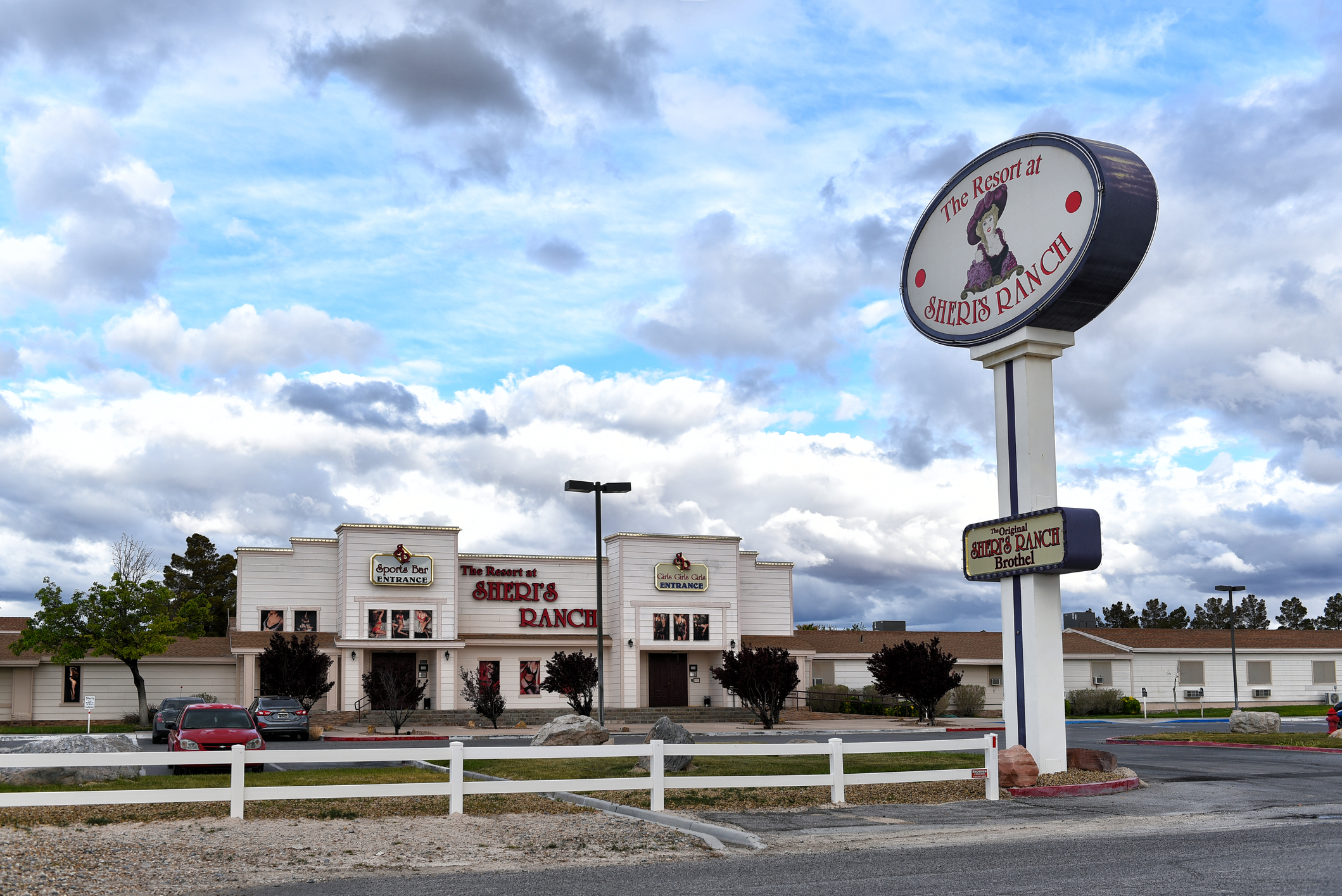
By the beginning of the 2000s, a couple of Nevada brothel operators were pushing the hospitality idea much further. When Chuck Lee bought Sheri’s Ranch in 2001, he quickly renamed it The Resort at Sheri’s Ranch and told the Los Angeles Times he wanted to turn the Pahrump brothel into a major resort operation. Some of the more ambitious ideas discussed at the time never happened, but the resort identity wasn’t just talk. By 2003, the Nevada Appeal reported that a $7 million expansion completed the previous year included a sports bar with a commercial kitchen, themed bungalows and Jacuzzi rooms.
Something similar was happening outside Reno. Before the permanent Wild Horse Canyon Ranch and Spa was finished, a 2002 Northern Nevada Business Weekly report said plans for the multimillion-dollar complex included a commercial kitchen and dining facilities, sports bar, swimming pool, Jacuzzis and saunas. When the finished property held its grand opening in 2003, owner Lance Gilman was unusually direct about what he was trying to build. He told the Associated Press that he wanted the Wild Horse known as a resort, spa and fine restaurant that also happened to have a brothel license.
Wild Horse handled its bar differently from many traditional houses. Customers entered through the Wild Horse Saloon, which operated as a separate business, and brothel customers continued through a door in the back. Gilman told the Record-Courier that men who only wanted to sit and drink shouldn’t have to be inside the brothel itself.
Nevada brothels had offered bars, pools, food and other amenities long before 2001. Chicken Ranch had even been flying customers in from Las Vegas twenty years earlier. What changed during this period was how openly some operators began presenting hospitality as part of the identity of the business. Sex was still the core business, while the property surrounding the transaction was becoming part of the experience too.
The Resort at Sheri’s Ranch.
The Restaurant Became a Destination Too
A bar gives someone who has already arrived at a brothel a place to settle in. A restaurant can give someone a reason to visit the property in the first place. That distinction is visible at both Sheri’s and Mustang today. Sheri’s describes its restaurant as “a destination in itself” and openly welcomes locals and curious visitors along with brothel guests. Mustang Ranch Lounge similarly promotes itself around freshly prepared meals, drinks and conversation, with a full menu that would look perfectly normal in plenty of Nevada bars and grills.
Dennis Hof took the idea in a slightly different direction when he opened NV50 near the BunnyRanch in December 2004. A contemporary Northern Nevada Business Weekly report described the $2 million restaurant and lounge as both a late-night hangout and a legitimate family restaurant, with about 40 employees, a 50-item menu and 60 wines and champagnes. Hof was emphatic that customers weren’t walking into a strip club disguised as a restaurant. At the same time, BunnyRanch promotional material promised its customers VIP treatment at NV50 and suggested the restaurant as a destination for outdates.
That combination makes NV50 an especially revealing example of brothel hospitality. Someone could go there simply for dinner or drinks, while the restaurant also gave BunnyRanch customers another place to extend their evening. By then, food had moved well beyond feeding the people who happened to live and work at a brothel. In some cases, the restaurant itself had become part of the attraction.
Hospitality Can Turn a Brothel Visit Into a Trip
Once lodging, dining and other amenities are added, a brothel visit can start to look very different from the traditional pattern of arriving, choosing a courtesan, negotiating a party and leaving. Sheri’s provides one of the clearest examples. In a 2010 Las Vegas Weekly interview, Air Force Amy described couples staying in the hotel for the weekend, seeing her during the stay and then returning to their room together afterward.
A few years later, Sheri’s was openly packaging that kind of experience. A 2014 Pahrump Valley Times article described “erotic vacation” packages for individuals and couples that included transportation from Las Vegas, two or three nights at the hotel, dinner with a courtesan and credit toward brothel services. Higher-end packages added things like bungalow experiences, champagne and an open bar.
The couples market was growing during the same period. Forbes reported in 2018 that when Sheri’s began tracking customer demographics in 2007, women and couples together accounted for less than 5 percent of visitors. By 2014, the two groups combined represented 15 percent, and by 2017 couples alone accounted for 15 percent. Those were Sheri’s reported customer demographics, and the article also noted that staff believed the hotel, restaurant, bar and other amenities made the property more comfortable for couples taking sexual vacations and that couples appeared more likely to make multi-day stays.
Those numbers don’t prove that resort amenities caused the growth in couples. Marketing, changing attitudes toward sex work and other factors likely played a role too. But the amenities clearly make a different kind of visit possible. A couple can check in, eat, have drinks, spend time by the pool, book a sexual experience and still have somewhere private to return afterward. By that point, hospitality is doing more than making the brothel comfortable. It’s helping shape the entire trip.
The Bar and the Brothel Aren’t the Same License
A brothel license doesn’t automatically give a Nevada brothel the right to sell alcohol. Nye County’s prostitution ordinance is unusually explicit on this point: a brothel license by itself does not authorize the license holder to sell, dispense or give away alcoholic beverages. The county’s licensing department also treats liquor and brothel licenses as separate privileges.
Lyon County provided an almost perfect demonstration in 2015. At a June 18 meeting, county commissioners convened as the Lyon County Liquor Board and approved a full-service liquor license application for the Pink Panty Palace Bar at 48 Kit Kat Drive in Mound House. They then adjourned that board, convened as the Lyon County Brothel Board and approved a brothel license application for the Kit Kat Ranch at the same address, pending approval of a special use permit. Same address, two different licenses and two different regulatory actions.
That separation is one reason alcohol rules can vary from one Nevada brothel to another. Having a licensed brothel and having a licensed bar on the property are related, but they aren’t legally the same thing.
From the Saloon to the Resort
So, can you eat or drink at a Nevada brothel? At several licensed houses, absolutely. Some operate public restaurants, others have bars where visitors can relax without immediately booking anything, and the exact rules vary from one property to another.
What’s more surprising is how old the basic idea is. Tonopah’s Big Casino was combining food, alcohol, entertainment and prostitution more than a century ago. Decades later, Chicken Ranch was flying customers in from Las Vegas, and by the early 2000s Sheri’s and Wild Horse were openly embracing the idea of the brothel as a hospitality destination.
The details have changed, but food, drinks and other amenities have long helped shape what happens before, after and sometimes instead of the trip to the boudoir.
Photo Attribution
Dolly Parton, 1977. RCA Records publicity photograph. Public domain in the United States, via Wikimedia Commons.
Spend enough time around Nevada’s legal brothels and a surprising number of perfectly ordinary words begin to mean something else. A party is a paid session with a courtesan. A woman can doctor without having a medical degree. A customer can arrive as a walk-in, become a request, later become a walk, and under certain circumstances also be a limo. A courtesan can be in house without being on the floor, while a longtime house girl may not even be at the brothel that week.
Then there are the terms that require considerably less help getting your attention. Dirty hustling and dick check both mean pretty much what people inside the industry expect them to mean, although probably not what an outsider would guess.
Much of this language becomes so routine inside the industry that it can be easy to forget how peculiar it sounds outside a brothel. Terms that initially seem too commonplace to include turn out to be among the most distinctly brothel-specific phrases on the list. Everyone knows what a doctor is. Far fewer people know what a courtesan means when she says she has to “doctor” before she can get back on the floor.
What follows is a selected collection of words and phrases associated with Nevada’s licensed brothel industry, concentrating primarily on terminology that is still used or recognizable today. This is not intended to catalog every bit of prostitution slang ever uttered in Nevada. Some expressions are widely understood across the industry, while others belong to particular houses, regions or periods. Brothels also develop their own vocabulary over time, so someone who has worked for years in Pahrump may occasionally encounter a perfectly legitimate term from another house and wonder what the hell everyone is talking about.
Lineups, Bar Calls and Requests
The lineup is probably the Nevada brothel ritual that requires the least explanation. A customer walks into the brothel and asks to meet the available courtesans. Depending on the house, a bell may ring or an announcement may come over the intercom: “Attention all ladies, we have a lineup.” The women head to the parlor, form an actual line and introduce themselves one by one. The Chicken Ranch’s current description of a lineup follows essentially this process, with a bell, a parlor, and the women coming out one by one to introduce themselves.
What the clinical description leaves out is the sudden interruption a lineup can create behind the scenes. A courtesan may be eating lunch, reading in her room or doing just about anything else when the call comes. Lunch gets covered with a napkin, the heels go on and she heads for the parlor. There is no reason to leave a newly arrived customer sitting around for 45 minutes while everyone finishes whatever they were doing. At houses with less formal dress expectations, women have even been known to arrive at a lineup straight from the shower wearing a towel. Being the woman in the towel does not necessarily hurt her chances of getting picked.
Lineups are intentionally brief. The women introduce themselves and give the customer a chance to see who is available. This is generally not the time for one courtesan to launch into an aggressive sales pitch, blow a kiss, wink repeatedly or otherwise turn her few seconds of introduction into a competitive advantage. Once that begins happening, the discussion can quickly move into another term on our list, dirty hustling.
The word lineup also escaped the parlor years ago. Brothels commonly use it for the online roster of women currently available. Before websites and digital displays became commonplace, some houses kept photographs of available women in a physical book. At Donna’s Ranch this was literally known as The Book. The modern equivalent may be a television screen in the bar cycling through profiles. A customer who does not want a formal lineup can look through the available women and decide whom he or she would like to meet.
A bar call is another variation. Instead of lining everyone up in the parlor, the available courtesans meet the customer one-by-one in the bar where introductions can be more lengthy and conversational. A Nevada brothel courtesan has describedbar calls and lineups as separate parts of brothel life, including the familiar scramble to freshen up when either is announced. The terminology should not be assumed to be universal at every house, but the distinction is real.
A request sounds even more obvious. A customer has already seen a particular courtesan online, on a bar monitor or during a previous visit and asks to speak with her. A hostess might call her room and say, “Regina, you have a request in the bar.”
The more interesting part is what happens to the grammar. Inside a brothel, the customer can become a request. A courtesan might notice someone sitting at the bar and ask the hostess whether anyone is talking to him. The response could be, “No, he’s a request.” Translation: he has specifically asked for another courtesan, so for the moment he is spoken for.
This peculiar habit of turning customers into nouns appears throughout brothel language. The same person can begin the evening as a walk-in, become a request, later turn into a walk and, depending on how he arrived, also be a limo. Once that sentence makes sense, the language of Nevada brothels starts becoming considerably easier to follow.
Dirty Hustling
There is competition in a brothel. Several courtesans may be interested in the same customer, and only one of them is likely to leave the bar with him. Competition by itself is perfectly normal. Dirty hustling begins when a courtesan breaks the house rules to give herself an unfair advantage over another woman.
The easiest examples happen during a lineup. The basic idea is that everyone gets roughly the same opportunity to introduce herself. A courtesan who adds an extra wink, blows the customer a kiss, makes a suggestive gesture or otherwise finds a way to command more attention may be accused of dirty hustling. A 2015 Pahrump Valley Times article devoted part of its discussion of brothel rules to dirty hustling, describing the little things a woman might do to surreptitiously catch a customer’s eye.
Dirty hustling is not limited to the lineup. Imagine that a courtesan has been talking with her regular customer at the bar for several minutes and excuses herself to use the restroom. Another woman sees the opening, slides into the conversation and tries to take over the customer before the first courtesan returns. That can qualify too. The exact rules vary by house, but the underlying idea is remarkably simple: dirty hustling is violating the rules of fair competition to gain an edge over another courtesan at some point in the customer experience.
The term also helps explain why brothels develop internal rules governing competition. The women are independent contractors competing for business while simultaneously sharing the same bar, parlor, customers and workplace. There has to be some understanding of whose customer is whose, when someone is available to approach and what everyone is allowed to do while competing for attention. Without those rules, every trip to the restroom could become a potentially expensive mistake.
Tours
A tour in a Nevada brothel usually refers to a courtesan’s scheduled period of work at a particular house. A woman might announce that she is touring a brothel from March 5 through March 18, meaning those are the dates she expects to be there and available for customers. Current courtesan websites still use Tour Dates as a heading for brothel availability.
Many courtesans do not maintain anything resembling a conventional Monday-through-Friday workweek. A woman may travel to a brothel, remain there for a week or two, leave for several weeks and return for another tour later. Some spend years touring almost exclusively at one property. Others work at different legal brothels during different periods of their careers.
This is also why tour and house girl are related but do not mean the same thing. A house girl may repeatedly tour the same brothel for years and become closely identified with it, even though she is not physically there every week of the year.
Unfortunately for anyone trying to learn brothel vocabulary, tour also retains its normal English meaning. Nevada brothels routinely give visitors actual tours of their properties, including people who are simply curious and have no immediate intention of booking a party. The Chicken Ranch, for example, currently advertises free property tours. The word also appears during the normal progression of a customer visit. After meeting a courtesan, she may offer to show the customer around the property, specialty rooms or amenities, with the tour eventually ending in her private room where the negotiation takes place.
So when someone says, “She’s on tour at the ranch,” the woman is probably working there. When a customer says, “She took me on a tour of the ranch,” he probably saw the building. Context once again keeps everybody sane.
Negotiation
Negotiation is one of the least exotic-sounding terms in Nevada brothel vocabulary, but it describes one of the most important parts of a legal brothel visit. After a customer meets a courtesan and decides he or she would like to continue the conversation, the two generally go somewhere private to discuss the proposed party.
The negotiation covers much more than price. The customer explains what kind of experience is desired, how much time is being considered and any particular interests or fantasies. The courtesan explains what she is comfortable offering, establishes her boundaries and determines what she will charge. Current Chicken Ranch material likewise describes negotiation as a private stage in which the courtesan sets her own price based on the services and time involved.
This process can surprise first-time visitors who expect brothels to work like restaurants, with a fixed menu and a price printed beside every item. Nevada courtesans set their own rates. Two women at the same brothel may quote different prices for superficially similar parties, and the same courtesan may price different experiences differently depending on the time involved and what the customer is asking her to do.
Negotiation can sound more adversarial than the process necessarily is. It does not have to resemble two attorneys arguing over the sale of a used-car dealership. Sometimes the customer explains what he wants, the courtesan gives him a price, he agrees and the negotiation is over. In other cases there may be considerable discussion about time, activities or budget before both sides decide whether they have a deal.
Either side can also decide that they do not. Choosing a courtesan from a lineup, requesting her by name or following her to a private room does not guarantee that a party will occur. If the customer and courtesan reach an agreement, they can book the party. If they cannot, the customer may be walked back into the house and meet someone else. That is where the next term begins.
Walks and Price Walks
When a negotiation does not produce an agreement, the courtesan may walk the customer. Depending on the house, she may bring the customer back to the bar or parlor, to a designated area sometimes referred to as a walk room, or back to a hostess or other staff member. The failed negotiation does not necessarily end the visit. The customer can meet another courtesan who may be a better fit and ultimately book a party.
This is one of the more interesting differences between brothel sales and a one-person business. If a solo service provider and prospective customer cannot reach an agreement, the transaction is probably finished. In a brothel, other courtesans are still in the building and staff can help the customer navigate those alternatives. One unsuccessful negotiation can become somebody else’s successful booking.
Again, the customer can become the noun. Someone might say, “He started as a request for Jenny, but now he’s a walk.” That means the customer initially came in asking for Jenny, the two did not reach an agreement and he is now available to meet someone else.
There is a second meaning that depends entirely on context. “Jenny walked him” can mean Jenny ended the negotiation and returned the customer to the house. “That customer walked” may mean the customer simply left without booking anyone. People who work around brothels generally have no trouble distinguishing the two.
A price walk is a more deliberate version of the failed negotiation. Instead of simply ending the discussion, a courtesan quotes a price she expects the customer to reject because she has decided she does not want the party. A Mustang Ranch courtesan has described price walking as quoting an exorbitant price when a negotiation has become annoying, while saying she personally prefers simply ending the negotiation.
There is an obvious danger in outsiders trying to diagnose a price walk from the number alone. One party can be completely different from another in length, activities and circumstances. A price that seems outrageously high to one person may be precisely what a particular courtesan charges for that particular experience. Price walk describes the intent behind the quote. The amount itself tells you very little.
The broader walk is more revealing because it shows how the brothel functions as a business. One negotiation went nowhere, but the customer may still be sitting 30 feet away from a room full of alternatives. In the vocabulary of the house, he has become “a walk.” He has not necessarily walked anywhere yet.
The Sofa, Henri de Toulouse-Lautrec, c. 1896. Public domain via Wikimedia Commons.
Parties, Two-Girls and Re-booking
Few words are more deeply embedded in Nevada brothel vocabulary than party. In its simplest form, a party is the private session that a customer books with a courtesan after the two have negotiated and agreed on the details. Inez’s D&D currently answers the question “What’s a party?” by defining it as private time with one of the women after the details have been agreed upon.
Party is also a verb. A courtesan might say, “I partied with him last year,” or ask another woman, “Have you ever partied with that customer?” In both cases, everyone understands that she is talking about a previous paid encounter, not a night involving balloons and a sheet cake.
The terminology becomes even more economical with a two-girl. A customer booking two courtesans together may be having a two-girl party, but inside the house the longer description is often unnecessary. A hostess might simply ask, “Are you available for a two-girl?” The wording remains current enough that Mona’s Ranch still lists Two Girl Party among its services.
A booking is what makes the party official. Once the negotiation is complete, the agreed party is recorded and payment is processed according to the procedures of the house. This is also where some older Nevada brothel vocabulary gets unusually colorful. At Dennis Hof’s BunnyRanch, the cashier or booking office was famously known as the Hooker Booker. The phrase is well documented in BunnyRanch-era accounts, but it is better understood as house-specific historical terminology than as something a visitor should expect to hear at every brothel today.
Then there is re-booking. If the original party is approaching its end and the customer wants to continue, additional time can be negotiated and booked. Mustang Ranch customers have described hearing an intercom reminder of “time to rebook” near the end of a timed party. In ordinary usage, saying that a customer “rebooked” during a party generally means the session was extended beyond the original agreement.
The Hof brothels historically used another variation, re-party, for essentially the same moment. The wording may differ by house, but the basic idea is easy enough to understand. The party is going well enough that somebody decided it should not end yet.
Walk-ins, Appointments, Limos and Kelly Fares
Customers entering a Nevada brothel tend to fall into a few broad categories, and once again the industry has a habit of turning those categories into nouns.
A walk-in is exactly what it sounds like: someone who arrives without a scheduled appointment. Walk-ins remain a normal part of the business. The Chicken Ranch’s current FAQ has separate entries for “Can I just walk in?” and “How do I book an Appointment?”, with walk-ins able to request a lineup and appointments used to arrange a visit with a chosen courtesan. Once inside, a walk-in may meet women in the bar, ask for a lineup or become a request after seeing a particular courtesan who catches his or her attention.
An appointment is a customer arriving specifically to meet a courtesan with whom arrangements have already been made. The customer may have communicated with her beforehand, and the house knows whom the customer is there to see.
Then there is a limo. In normal English, a limo is a car. In brothel language, it can also be the customer who arrived through a qualifying transportation arrangement.
A courtesan asking about someone in the bar might be told, “He’s a limo,” or she may ask the hostess, “Is that customer a limo?” The distinction exists because transportation to Nevada brothels has historically involved arrangements between brothels, drivers and customers. The Chicken Ranch, for example, currently advertises free limo service from Las Vegas.
Why does a courtesan care how the customer got there? Because certain transportation or referral arrangements can affect the economics of the resulting party. The exact financial arrangements vary and have changed over time, so there is little value in turning a glossary into an accounting lesson. The important linguistic point is that limo can identify the customer, not just the vehicle.
That leads to Kelly fare or Kelly fee, another term that has circulated for years in Nevada brothel discussions. A former Love Ranch North courtesan explained that “a Kelly” could refer to a limo, taxi, Uber or another transportation provider, with a fee affecting the economics of the booking. The arrangements are not handled identically at every house.
The term helps explain why a customer may suddenly stop being “the guy who came in from Vegas” and become simply a limo. Much like request and walk, one word can tell people inside the house quite a bit about the customer before anyone has discussed what he actually wants to do.
House Girls, In House and On the Floor
These three expressions sound as though they should mean roughly the same thing. They do not.
A house girl is a courtesan who has become closely associated with one particular brothel over a long period of time. She may return to the same property for tour after tour, sometimes for years, until customers and other women effectively regard it as her house. The designation is informal. Nobody receives a promotion letter announcing that she has achieved House Girl status.
The term has a long history in Nevada brothel culture. In a 2010 discussion comparing the Chicken Ranch and Sheri’s Ranch, a longtime courtesan recalled that she had once been what people called “a house girl” at Sheri’s and, in her case, actually lived there. That older usage is useful because it shows how the meaning has evolved. Residency could once be part of the idea. Today, house girl can describe a woman whose connection to a brothel comes through years of repeated tours even if she maintains a home somewhere else and spends substantial time away.
A house girl also tends to accumulate something less formal but often just as useful: institutional memory. She knows the rhythms of the property, the staff, the customs and the unwritten rules. Newer courtesans may naturally look to a longtime house girl for advice even when she holds no management title.
In house means something much simpler. The courtesan is physically at the brothel. Mustang Ranch’s current lineup section describes itself as the place to see which women are “in house” and ready to meet customers. Being in house, however, does not necessarily mean that a woman is currently working. She may have arrived for a tour but still be waiting for medical results, taking time off, sleeping or otherwise unavailable.
That is where on the floor comes in. A courtesan who is on the floor is actively working and available for normal brothel business. Off the floor means she is not. The phrase is more than casual slang in some jurisdictions. Wells’ current brothel code uses “off the floor” for a woman who cannot work while awaiting the required medical clearance and expressly includes the bar area in that restriction.
Put the terms together and a sentence that sounds confusing at first becomes quite precise:
“Jessica is a house girl and she’s in house, but she hasn’t cleared yet, so she’s not on the floor.”
Jessica has a longstanding affiliation with the brothel. She is physically there. She is not currently eligible to work.
A week later, Jessica could leave the property and still be a house girl, while no longer being in house. Another courtesan might be in house for her first-ever tour and already be on the floor. The three expressions describe affiliation, location and work status, respectively, which is why people inside a brothel rarely confuse them even though outsiders understandably might.
Doctor Day, Doctoring and Cleared
Among the more peculiar Nevada brothel terms is one that has been hiding in plain sight for decades: Doctor Day.
In 1986, UPI described Tuesday at the Chicken Ranch as “Doctor Day”, when 15 working women piled into a van for their required medical testing. The phrase was presented with no elaborate explanation because everyone at the ranch apparently knew exactly what Tuesday meant. Forty years later, the underlying testing requirements have evolved, but the language remains recognizable.
Inside the brothel, doctor can also become a verb:
“Did you doctor yet?”
“She still has to doctor.”
“She has to doctor if she wants to stay another week.”
No one hearing these conversations inside a Nevada brothel thinks the woman is about to perform surgery. To doctor means to undergo the medical testing required to continue working. The expression remains current, including a 2026 courtesan account that casually lists “weekly doctoring” among ordinary work expenses.
The next word in this little chain is cleared. Once the required testing has been completed and the appropriate results are received, a courtesan may be described as cleared or waiting to clear. Wells’ current code likewise requires clearance to return to work before a medically ineligible worker can return to the floor.
Several brothel terms can therefore be packed into a sentence that would sound slightly deranged anywhere else:
“Jessica is in house, but she’s waiting to doctor, so she won’t clear until tomorrow.”
To someone familiar with the business, this is perfectly clear. Jessica is physically at the brothel. She has not yet completed the medical process necessary to work, so she is not currently available for normal customer business.
A complete explanation of Nevada’s brothel health regulations could consume an article by itself. For this glossary, the interesting part is the language. Medical testing has been such a routine part of legal brothel life for so long that the industry took the word doctor, converted it into a verb and apparently never looked back.
DC, or Dick Check
Some Nevada brothel terminology is obscure. DC is not.
Short for dick check, a DC is the visual genital inspection performed before sexual activity. The courtesan looks for obvious signs of infection or other conditions that would make the encounter unsafe. Donna’s Ranch describes the inspection directly in its FAQ as “a DC, or ‘dick check’”, and the abbreviation has long been part of Nevada brothel vocabulary.
The inspection itself can be clinical or incorporated more smoothly into the encounter, depending on the courtesan and circumstances. Its purpose is straightforward. The name is even more straightforward.
Nevada regulations separately require condoms or other approved barriers for specified sexual activity, but dick check belongs to brothel practice rather than the formal language of the state health code.
Work Cards and Sheriff’s Cards
A work card, often called a Sheriff’s card in ordinary brothel conversation, is the local credential authorizing someone to work in a licensed brothel. It should not be confused with being medically cleared, although a courtesan may need both before she can go on the floor.
The exact procedures depend on the jurisdiction. Nye County, for example, currently distinguishes a Brothel Work Card – Courtesan from a Brothel Work Card – Employee. Courtesan applicants have an additional medical-clearance requirement connected to their work card, while other brothel workers go through the local work-card process without that same medical requirement.
This distinction is useful because outsiders sometimes assume a Sheriff’s card is some sort of statewide license to be a prostitute. The system is more local and more mundane than that. Counties regulate who may work in licensed brothels, and the work card documents that the person has satisfied the applicable local requirements.
So a woman can be physically in house, have finished doctoring, and still not be on the floor if the rest of her paperwork is not complete. Brothel language distinguishes these different stages with considerable efficiency.
Outdates
An outdate is an arrangement in which a courtesan leaves the brothel property with a customer for an off-property date or activity. The term remains in current use.
The word resembles the broader escort-industry concept of an outcall, but Nevada brothel usage has its own legal history and local rules. Storey County actually defines an escort service associated with a licensed brothel as “also known as ‘outdating’”.
That same code demonstrates why outdate should not automatically be interpreted as “prostitution somewhere other than the brothel.” Storey County restricts its licensed escort activity to activities such as dining, entertainment, gambling, dancing, shopping and sightseeing, and prohibits prostitution or solicitation of sexual activity away from the licensed operation. Other jurisdictions have handled outdates differently over time.
For glossary purposes, the clean definition is deliberately narrow: an outdate means the courtesan is leaving the brothel property with the customer under whatever rules apply to that house and jurisdiction.
Someone inside the brothel might simply say, “She’s on an outdate,” in much the same way another person might say, “She’s in a party.” The legal details behind that sentence can be considerably more complicated than the sentence itself.
Courtesan
Few terms in Nevada’s brothel industry have had as much trouble settling into place as courtesan.
For years, the obvious choices all came with problems. Sex worker is widely used and generally less stigmatizing, but it is also an umbrella term that can include strippers, cam girls, porn stars and others who do not engage in prostitution. Prostitute is more precise, but it carries considerably more baggage. Even academic researchers studying Nevada brothels have wrestled with the terminology. In a study of Nevada’s legal brothels, Sarah Jane Blithe and Anna Wiederhold Wolfe noted that many women preferred sex worker, but the researchers used prostitute because sex worker could encompass several other occupations.
Courtesan has gradually filled some of that gap. Brothels have used the word for years as a professional designation, but in Nye County it has also moved beyond marketing language and into government usage. The county formally amended its brothel ordinance in 2019 to use Courtesan, and current Sheriff’s Office work-card materials continue to distinguish a Brothel Work Card – Courtesan from a Brothel Work Card – Employee.
That official recognition is significant because Nevada does not have one statewide vocabulary for prostitution. Older statutes, county codes, academic papers and newspaper articles may still use prostitute. Individual brothels may favor courtesan, lady or other language. BrothelNevada generally uses sex worker when discussing the broader occupation and courtesan when the specifically Nevada brothel context makes the term useful.
Dennis Hof took the naming exercise considerably further. His various brothels promoted their women under house-specific nicknames such as BunnyRanch Bunnies, Love Ranch Lovers, Sagebrush Ranch Starlets and Alien Cathouse Cosmic Kittens. Those were branding terms, not Nevada-wide occupational categories. A Cosmic Kitten did not become a different species of sex worker by driving from one county to another.
For purposes of this glossary, courtesan is best understood as a professional term for a sex worker practicing legally inside a licensed Nevada brothel, with the added wrinkle that Nye County now uses the word itself.
Chicken Ranch in Pahrump. “Ranch” has become so closely associated with Nevada brothels that the word can function almost as shorthand for the business itself.
House, Ranch and Parlor
A Nevada brothel may be called a brothel, a house, or quite often a ranch. Those words overlap, but each carries a little history of its own.
House is probably the simplest. It is ordinary shorthand for the brothel itself. Someone might say a courtesan is moving to another house, returning to her home house, or has worked at several houses during her career. The terminology also has a formal ancestor in the longstanding legal phrase house of prostitution, which still appears throughout Nevada law and historical records.
Ranch is more distinctly Nevadan. Mustang Ranch, Chicken Ranch, BunnyRanch, Sheri’s Ranch, Donna’s Ranch and numerous closed houses have all carried the word. By now, ranch can function almost as a synonym for brothel even when nobody on the property has seen a cow in years.
The origin is more complicated than the popular story that Nevada simply copied the famous Chicken Ranch in Texas. Nevada was already using ranch in connection with prostitution by the 1950s, and the word had much older Western associations with lodging, hospitality and prostitution. BrothelNevada looked at that history in detail in Why Are So Many Nevada Brothels Called “Ranches”?.
Then there is the parlor. In brothel usage, the parlor is generally a customer-facing common area where introductions or lineups may take place. The Chicken Ranch’s current description of a lineup, for example, tells customers they will be seated in the Parlor while the available women assemble.
The word sounds almost Victorian now, which may be part of its charm. A customer sitting in a Nevada brothel parlor is not necessarily waiting for tea.
Madams, House Moms and Hostesses
Nevada brothels have accumulated a collection of titles for the women who manage the house, look after the courtesans or deal directly with customers. The complication is that madam, house mom and hostess do not form a neat statewide chain of command.
A madam is the most familiar term. Traditionally, it refers to the woman running or supervising a brothel, although the exact duties depend heavily on the property and era. A madam may oversee courtesans, handle customer or operational issues, enforce house rules, supervise staff or serve as the public face of the business. At some houses, there may be another manager above or alongside her. At others, the madam is clearly the person running the day-to-day operation as a true general manager.
A house mom, sometimes house mother, can overlap substantially with that role. The title may describe someone who looks after the women, helps maintain order and provides an experienced point of contact inside the house. At some brothels, the house mom can effectively function as the madam. At others, the two are separate positions.
A useful example comes from the Love Ranch in 2018. Contemporary reporting identified one woman as the brothel’s madam while separately identifying another as the house mom. The two titles clearly referred to different people at that particular property. That does not make the Love Ranch arrangement a template for every other brothel in Nevada.
The hostess is usually more directly connected to the customer experience. Depending on the house, a hostess may greet arriving customers, call lineups, arrange introductions, locate a requested courtesan, receive a customer after a walk and help keep the front of the house moving. Older Nevada brothel accounts sometimes use terms such as floor maid or parlor maid for roles that overlap with what would now often be described as a hostess.
Trying to draw a statewide organizational chart creates more confusion than it solves. A title that carries considerable authority at one brothel may describe a narrower role somewhere else. The safest translation is functional: madam generally suggests management, house mom suggests an experienced house-support or management role, and hostess usually points toward front-of-house customer handling. The borders between them have never been especially rigid.
Big Sister
A big sister is an experienced courtesan who helps a newcomer learn how to work in a brothel. The role is part trainer, part mentor and, traditionally, part guide through the peculiar collection of rules and customs that a new courtesan has probably never encountered anywhere else.
That can include explaining lineups, negotiations, house etiquette and the basic rhythm of a customer visit. In some cases, a big sister has even accompanied a new courtesan into her first few negotiations so she can watch how an experienced woman handles the conversation. Recent academic research on Nevada’s legal brothels describes essentially this arrangement, with a worker explaining that a new courtesan may be paired with a more experienced woman who shadows her and joins early negotiations.
The practice is not new, although its formality has varied from house to house. At one property, management may deliberately pair a newcomer with a veteran. Somewhere else, an experienced courtesan may simply take a new woman under her wing because somebody needs to explain what happens after the lineup bell rings.
The term is useful because big sister is not the same thing as house mom. A house mom is generally a staff or management role. A big sister is another working courtesan helping a less experienced courtesan learn the job.
The more formal version of the practice appears to have become less common over time, particularly the arrangement in which a veteran courtesan joins a newcomer through her first negotiations. The term remains part of Nevada brothel vocabulary even as the practice behind it has become less standardized.
Illustrative stock image. Nevada brothels have developed their own vocabulary around bookings, competition and sales, including “Top Booker” and “house minimum.”
Top Booker
A Top Booker is one of the highest-producing courtesans in a brothel over a given period of time. The word booker in this context has nothing to do with managing a reservation calendar. It comes from bookings, meaning completed business.
The term has been used at multiple Nevada brothels. A court complaint involving a woman who worked at the Chicken Ranch in the 1980s described her as having become a “top booker”, while the term became particularly visible during the Dennis Hof era. Hof made sales competition an overt part of the culture at his properties. Top-performing women were recognized, rankings were discussed and prizes were awarded.
At the Hof brothels, those prizes were handed out during the Tea Party, another bit of house-specific terminology. Despite the name, Tea Party was essentially a company meeting. An ethnographic study of the BunnyRanch describes the weekly Tea Party, top-earner announcements and Top Booker prizes. The combination of Tea Party and Top Booker captures something distinctive about Hof’s management style. He did not hide the sales competition. He turned it into part of the culture.
That approach should not be mistaken for a Nevada brothel standard. Some houses have historically kept sales information considerably more private, and not every brothel wants its courtesans publicly comparing numbers or competing for weekly recognition.
Nor does Top Booker necessarily mean the woman landing the occasional enormous party. Consistently booking customers at different price points can produce more business than waiting around for the rare spectacular transaction. There can be more than one route to the top of the board.
For an outsider, the simplest translation is top salesperson, although that loses some of the peculiar flavor of the original. Nobody at a Nevada brothel is likely to hand out a plaque for Sales Associate of the Month when Top Booker will do.
House Minimum
House minimum sounds like it should have an easy definition: the lowest price a brothel allows a courtesan to charge for a party. Nevada brothel history makes it considerably messier.
Christina Parreira provides one of the better examples. While conducting doctoral research, Parreira worked legally inside Nevada brothels and described a period at a small house where several women became frustrated when other courtesans accepted very low-priced parties. The women eventually got together and agreed among themselves on what they called a house minimum. Management had not imposed the price. According to Parreira, it was an informal agreement among the courtesans because they believed extremely low prices were hurting the perceived value of the house.
Even that agreement had an obvious enforcement problem. Negotiations took place privately. One courtesan did not necessarily know what another woman had actually charged behind a closed door. Parreira described arguments over women believed to be charging too little, but ultimately each negotiation remained private.
Other Nevada brothels and other periods have produced somewhat different versions of the same concept. A former Love Ranch South madam told The Nevada Independent that the women there generally tried to agree on a minimum price, while acknowledging that women sometimes broke the agreement because they wanted the business. Older research has documented more formal minimum-price practices at certain houses, while other brothels have operated without a meaningful house minimum at all.
That history is why house minimum is better understood as a piece of brothel vocabulary than as a universal Nevada pricing rule. At one house it may describe an informal understanding among the women. Somewhere else it may have reflected a more established house practice.
Customers sometimes use the phrase as though every Nevada brothel has a secret minimum price carved into a stone tablet somewhere in the back office. The reality has always been less tidy.
Parreira’s example may be the most revealing precisely because nobody officially created the rule. A group of women working together decided there ought to be a bottom, gave that bottom a name, and discovered that convincing everyone to honor it was another matter entirely.
Henri de Toulouse-Lautrec, The Sofa (Le Sofa), c. 1896. Source: The Yorck Project (2002), 10.000 Meisterwerke der Malerei. Public domain via Wikimedia Commons.
Nevada has had two organizations called the Nevada Brothel Association, separated by years and built under very different circumstances. The first emerged in 1985, when the AIDS crisis and renewed political pressure forced brothel owners who normally operated independently to find a way to speak collectively. The second appeared after Dennis Hof’s death in 2018, during another period when legal prostitution faced organized political opposition.
The first developed over time as an owners’ association with leadership extending across independently operated brothels. George Flint, a longtime Nevada lobbyist, became its enduring political representative, but the surviving record also shows brothel owners from different companies serving in leadership positions. The revived organization was structured differently from the beginning: it registered as a political action committee and was created by people from Hof’s brothel and political network before reaching outward to other operators. Those differences are easier to see in the historical record than in the shared name.
The Original Nevada Brothel Association
AIDS Forces Nevada’s Brothel Owners to Organize
The best-supported published history places the formation of the Nevada Brothel Association in the spring of 1985. Sociologists Barbara Brents, Crystal Jackson and Kathryn Hausbeck write in The State of Sex that Nevada brothel owners came together that year and decided to form an association. Joe Conforte, the powerful owner of the Mustang Ranch, encouraged the effort and asked George Flint, an established Nevada lobbyist, to help organize it. By 1986, 22 owners had joined, and Flint was preparing to represent them during the 1987 Legislature.
AIDS made cooperation unusually urgent. Nevada’s brothels were legal only in counties that chose to license them, and the emerging epidemic gave opponents a powerful new argument for shutting the system down. The owners also had a practical problem: health policy was becoming a statewide issue even though brothel licensing remained local. An industry built around fiercely independent businesses suddenly needed a common response.
Nevada had already begun requiring HIV testing of licensed brothel workers before the Legislature took up Assembly Bill 550 in 1987. The law that passed that June went further. Among its provisions, it made it a felony for someone to continue working as a prostitute in a licensed house after testing positive for HIV and receiving notice of the result, and it created potential civil liability for an owner or operator who knowingly continued employing a worker who had tested positive. Nevada’s 1987 statutes document those provisions.
The Chicken Ranch
Russell Reade Emerges as an Early NBA Leader
The association’s early history is important because it shows that the organization was not simply George Flint using a statewide title. Russell Reade, an owner and manager of the Chicken Ranch in Nye County, emerged as one of its first identifiable owner-leaders. On April 23, 1987, the official legislative history of AB 550 identified Reade as the Chicken Ranch’s owner-manager and as a representative of the “Nevada Association of Brothels.” He testified in support of the AIDS legislation and described the health practices being used by licensed houses.
By January 1988, contemporary reporting was more explicit. United Press International identified Reade as president of the Nevada Brothel Association when the State Board of Health adopted a mandatory-condom regulation. Reade said the Chicken Ranch had already required condoms voluntarily and that the association supported the statewide rule. By June 1990, UPI was identifying him as a past president. That sequence – president-elect in the association’s early period, legislative representative in 1987, president by 1988 and past president by 1990 – is unusually strong evidence of genuine owner leadership separate from Flint.
George Flint Becomes the Industry’s Permanent Political Voice
Flint’s role was different. He was the professional who stayed. Over the following decades he became the industry’s longtime political representative, appearing repeatedly before lawmakers, monitoring bills and maintaining relationships in Carson City. By 1992, medical literature discussing outside research in Nevada identified him as executive director of the Nevada Brothel Association. A later medical-journal account describes how Flint helped researcher Alexa Albert gain unusually broad access to the Mustang Ranch that year.
That episode shows a side of Flint’s job that is easy to miss if his career is reduced to legislative testimony. Albert had spent years trying to gain access to a legal brothel for research. According to the published account, Flint invited her to Nevada and arranged for her to spend time at the Mustang Ranch, where she was eventually allowed around-the-clock access. The research became the basis for her book Brothel: The Mustang Ranch and Its Women. Flint was functioning not just as a lobbyist but as a gatekeeper between a guarded industry and an outside researcher.
The NBA Puts Money Behind Public Health Research
The association also put money behind research of its own. In 1990, UPI reported that researchers had examined seven years of medical and employment records involving 246 women who had worked at the Chicken Ranch. The work was supported by a $21,000 grant from the Nevada Brothel Association. The researchers reported no HIV cases in the study group and low rates of sexually transmitted disease.
The study did not prove that every Nevada brothel was disease-free, nor should it be used that way. What it does establish is that the NBA had accumulated enough collective resources to finance outside public-health research at a moment when the industry’s survival was closely tied to whether Nevada could defend its regulatory system with evidence rather than reassurance.
A Broad Association, But Never a Fully Unified Industry
The original NBA appears to have developed broad participation, but Nevada’s brothel owners never moved in lockstep. That distinction becomes important whenever old newspaper stories say Flint “represented” every brothel or nearly every brothel in the state. Representation, formal membership, financial support and organizational control are not the same thing.
By 2005, Flint was telling the Reno Gazette-Journal that the Nevada Brothel Owners Association represented about 18 of Nevada’s 27 legal brothels and roughly 90 percent of the industry’s business. Those were Flint’s own figures, not an audited membership list, but they show that he was describing a substantial coalition while acknowledging that other houses remained outside it.
The historical gaps are real. UNLV Special Collections holds Nevada Brothel Association folders covering approximately 1990 to 1999 in the Kathy Eastland Papers. Those materials are not currently available online, and Brothel Nevada has not yet reviewed the physical files. They may eventually clarify membership, dues, officer changes and internal governance that cannot be reconstructed confidently from the public record alone.
Geoff Arnold and a Second Generation of Owner Leadership
The clearest later example of owner leadership is Geoff Arnold. In January 2005, the Northern Nevada Business Weekly identified Arnold as president of the Nevada Brothel Association when he appeared before Churchill County commissioners to discuss proposed changes to their brothel ordinance. The article said Arnold owned brothels in Wells and Battle Mountain. Academic researchers likewise described Arnold as the head of the association while separately describing Flint as its lobbyist.
That separation of roles is useful. Flint may have been the person lawmakers and reporters saw most often, but Reade and Arnold show an organization in which an owner could occupy the presidency while a professional lobbyist handled much of the day-to-day political work. It is one of the strongest differences between the first association and the surviving governance record of the second.
The Nevada Brothel Association or the Nevada Brothel Owners Association?
The historical record becomes confusing in the 2000s because the organization appears under two closely related names: Nevada Brothel Association and Nevada Brothel Owners Association. Contemporary reporting could call Arnold president of the Nevada Brothel Association while official legislative records from the same period identified Flint as president of the Nevada Brothel Owners Association.
The inconsistency is not confined to newspaper shorthand. During a March 30, 2005 hearing, the official legislative history of AB 250 identifies “George Flint, President, Nevada Brothel Owners’ Association.” Two weeks later, Assembly committee minutes again identify Flint as president of the Nevada Brothel Owners Association. At roughly the same time, Arnold was still being described publicly as president of the Nevada Brothel Association.
The available records do not fully explain the overlap. The two names may have been used interchangeably, may have reflected different formal or public-facing identities, or may simply have been applied inconsistently by participants and reporters. There is not enough evidence to choose among those possibilities, and the article does not treat them as proven separate organizations.
Flint’s Value Was Often in the Bills That Were Not About Brothels
Some of the best evidence of what the old association actually did comes from legislation that was not primarily about prostitution. In the March 2005 massage-therapy hearing, Flint explained that statewide massage regulation had concerned the brothel association for years because broad language could inadvertently place licensed brothels under a new massage-regulatory system. He supported the measure once licensed brothel activity was expressly exempted. The legislative record preserves that exchange.
That kind of work was less visible than a dramatic fight over whether brothels should remain legal, but it was exactly the sort of problem a permanent trade-association lobbyist was positioned to catch. The value was often preventive: read a bill that appeared to be about another industry, recognize how a definition might reach brothels, and get the language corrected before it became law.
Dennis Hof
Dennis Hof Takes a Different Approach
By the middle of the 2000s, Dennis Hof had become one of Nevada’s most nationally recognizable brothel owners. HBO’s Cathouse had turned the Moonlite BunnyRanch into a national media brand, and Hof was increasingly willing to pursue his own political positions rather than simply follow the association’s consensus.
The 2005 tax fight is a clear example. The Washington Post identified Geoff Arnold as president of the Nevada Brothel Association and George Flint as its lobbyist while reporting that Hof opposed the proposed state brothel tax. Hof argued that brothels were already paying their fair share and should not have to accept a new tax merely to gain political legitimacy. The disagreement establishes a public split over policy; it does not, by itself, establish Hof’s formal membership status at that exact moment.
The separation was even clearer in 2009. Official Senate Taxation minutes list Flint for the Nevada Brothel Owners Association while Hof appeared separately as owner of the Moonlite Bunny Ranch and Love Ranch. Both were speaking about the same industry, but they were not appearing as a single delegation.
The Original Association Begins to Fade
The old association did not simply vanish at the end of the 2000s. In Nevada’s 2010 special session, Flint was still appearing for the Nevada Brothel Owners Association, and the Senate Journal records him saying that his board had unanimously authorized him to renew the industry’s proposal for a $5-per-transaction tax. That is unusually direct evidence that some formal governance still existed.
By 2011, however, Nevada’s official lobbyist records were using a different client name: Select Legal Brothels of Nevada. The same name appears again in the 2013 employer list. The records do not tell us whether this was a formal successor organization, a narrower consortium of Flint’s remaining clients or simply a different lobbying designation, so the safest conclusion is that the traditional association structure had become less visible even while Flint continued representing brothel interests.
The final shift is documented in 2015. Nevada’s official paid-lobbyist list shows Flint representing Dennis Hof Enterprises directly rather than a statewide brothel association. That same spring, Flint suffered a heart attack and retired. The Los Angeles Times reported that the political-contribution budget associated with the brothel owners’ group had fallen from roughly $100,000 a year to about $20,000 as the industry contracted. Flint’s retirement did not necessarily mark a formal dissolution on a specific date, but it removed the political professional who had carried the industry’s collective presence in Carson City for three decades.
BunnyRanch roadside sign
The Revived Nevada Brothel Association
A Brothel Fight, Hof’s Death and a New Association
By 2018, Nevada’s brothel industry had gone several years without anything resembling the old statewide owners’ organization. Flint was retired, and Hof had become the industry’s most visible political and media figure. Hof was also running as a Republican for Nevada Assembly District 36.
That year legal brothels became an election issue in Lyon County. Voters were asked whether the county should rescind its brothel ordinance. The four licensed brothels in the county were Hof properties in Mound House. The proposal was decisively rejected: final reporting put the vote at 16,643 against rescinding the ordinance and 4,031 in favor. Northern Nevada Business Weekly reported the result as part of its later review of the industry’s political fight.
Hof died on October 16, 2018, less than three weeks before Election Day. The campaign continued without him. Alice Little and Ruby Rae, two licensed sex workers from Hof’s brothels, had already become visible defenders of the Lyon County houses, while Chuck Muth, Hof’s campaign manager, was involved in the political effort.
The Nevada Brothel Association PAC filed with the Nevada Secretary of State in November. Associated Press identified Suzette Cole, who managed Hof’s four Lyon County brothels, as director and Muth as spokesman. Muth said the Lyon County fight had helped spur the group’s formation and that the new association intended to oppose the anticipated statewide prohibition effort. AP also reported that the organization planned to reach out to other brothel owners and invite them to join.
A January 2019 Pahrump Valley Times report gave more detail, attributing the launch to a Hof-team announcement. It said the PAC was formed by Cole, Little and Rae, with Muth serving as registered agent and spokesman, and described the founding group as coming from Hof’s four Lyon County houses: Bunny Ranch, Kit Kat Ranch, Love Ranch and Sagebrush Ranch. The announcement said other operators would be approached before the Legislature convened.
“We Don’t Need Dennis to Represent Us Anymore”
Little’s own explanation captured what the new organization was trying to become. In a January 2019 interview with The Record-Courier, she said: “Dennis did Dennis, and we’re not trying to be Dennis. Something new is going to happen. The women who work at the brothels are going to make something new … and we don’t need Dennis to represent us anymore.” The article said Little viewed her participation in the revived Nevada Brothel Association as part of that effort.
The statement marked a real change from the old model. The first NBA had been an owners’ association whose most durable public representative was a professional lobbyist. The revived group put sex workers themselves much closer to the front of its public advocacy, a shift that became particularly visible when Little and Rae appeared before the Legislature as NBA ambassadors.
Did the New NBA Really Represent 21 Brothels?
Contemporary reporting almost immediately produced a membership puzzle. A January 16, 2019 article said the new NBA “represents 21 legal brothels across seven counties.” But the same article said the organization intended to seek owners to join, and it quoted Muth saying, “We haven’t spoken with the other brothel operations yet.” The article itself therefore makes it impossible to treat “21 brothels” as a reliable formal-membership count.
The same evidentiary rule applies to both generations of the NBA. A public claim that an organization represents a brothel is not proof that the owner formally joined it. Membership is not proof of financial support, and financial support is not proof of organizational control. For the revived NBA, the public record clearly establishes a Hof-centered founding group and later cooperation with independent houses. It does not provide a complete dues-paying membership or voting roster.
The New NBA Goes to Carson City
The revived association did become an identifiable participant in the 2019 Legislature. On March 28, the official Assembly minutes on ACR 6 identify Alice Little and Ruby Rae as Nevada Brothel Association ambassadors. Rae told the committee that she would read a statement from Suzette Cole, identified as president of the Nevada Brothel Association.
The association supported studying Nevada’s legal brothel system while urging lawmakers to consider issues such as illegal sex work, geographic restrictions, advertising rules and the composition of the study committee. ACR 6 ultimately passed as a legislative study resolution. The adopted resolution provides a formal record of the Legislature’s decision to examine the issue.
Other Brothels Still Spoke for Themselves
The existence of a statewide-sounding association did not mean every brothel began speaking through it. Independent operators continued developing their own positions and advocacy efforts. Bella Cummins, owner of the Hacienda Ranch in Wells, created the Onesta Foundation and publicly discussed her own goals for regulation, research and worker treatment in early 2019. Northern Nevada Business Weekly reported on that separate effort while the revived NBA was getting started.
The legislative record also shows individual houses presenting their own voices. Sheri’s Ranch front manager and madam Dena Duff submitted a written statement to the Legislature in her capacity at Sheri’s; the official exhibit identifies her title and role. Mustang owner Lance Gilman likewise communicated his own position during the ACR 6 debate. Separate advocacy does not prove that a house was or was not an NBA member, but it does show that the revived association never became the only channel through which Nevada brothel operators addressed government.
COVID Forces Brothels Into Closer Cooperation
The strongest evidence of the revived NBA doing genuine multi-owner coordination came during the COVID-19 shutdown. Nevada ordered brothels closed in March 2020, and they remained shuttered far longer than many other businesses. As the industry argued for a path to reopening, the association published a common set of health and safety measures.
The NBA’s published protocol said the measures had been adopted by eight brothels: Bunny Ranch, Kit Kat Ranch, Sagebrush Ranch and Love Ranch in Lyon County, plus Mona’s Ranch, Inez’s D&D, Desert Rose and the Desert Club. The four latter houses were independently operated outside Hof’s former company. Whatever their formal membership status, those businesses had agreed to a shared operational framework published through the association.
Other houses also acted independently. The Nevada Independent reported separate efforts by Mustang Ranch and Chicken Ranch representatives to persuade state officials to allow brothels to reopen. The picture is therefore more complicated than either “the NBA represented everyone” or “the NBA only represented the former Hof houses.” It coordinated some statewide activity while independent operators continued to speak and act on their own.
Alice Little
Alice Little Takes the Governor to Court
In October 2020, Alice Little took a much more aggressive route. She sued Gov. Steve Sisolak, asking a court either to allow Nevada’s licensed brothels to reopen or to permit legal sex workers to work from private homes or other locations outside the licensed houses. The Nevada Independent reported that the lawsuit challenged a shutdown that by then had lasted for months.
In January 2021, District Judge Leon Aberasturi denied Little’s request for a preliminary injunction. The court noted that Little was an independent contractor rather than a brothel owner and that no brothel owners had testified about the effect of the governor’s directives on their businesses. Little told The Nevada Independent that she had spent more than $50,000 pursuing the case while out of work and said some owners had been willing to join as long as she continued financing the litigation.
Suzette Cole took a different position. Cole was running the former Hof brothels and serving as president of the Nevada Brothel Association. When asked about the reopening effort, she told The Nevada Independent that she had “no intention of joining” and that the brothels would reopen when the governor allowed them to.
Little had helped form the association, represented it publicly and appeared before lawmakers as an NBA ambassador. Her lawsuit, however, appears to have developed largely as her own effort rather than as a coordinated NBA strategy. It also went considerably beyond simply asking Nevada to reopen the brothels, seeking as an alternative to allow licensed sex workers to work from homes or other private locations. Cole pursued a different strategy. The episode shows two prominent figures in the same association taking very different approaches during the COVID shutdown.
When Nevada’s brothels were finally permitted to reopen on May 1, 2021, Little did not return to the Bunny Ranch. She resumed legal sex work at the independently operated Chicken Ranch in Nye County, a move reported by The Nevada Independent. There is no evidence establishing that Cole’s position on the lawsuit caused Little to leave the Bunny Ranch, and the sequence should not be presented that way. Little’s move nevertheless belongs in the history of this period.
The NBA Begins to Recede From View
The association’s visible public activity declined after the brothels reopened. Its website’s publishing activity slowed sharply, and by May 2022 there was a more concrete sign of reduced engagement. Minutes of Nevada’s Advisory Task Force on HIV Exposure Modernization state that the Nevada Brothel Association had been contacted but had not responded. The state meeting minutes support that narrow conclusion; they do not establish that the organization had ceased to exist.
The distinction became more important with time. Chuck Muth continued to be publicly associated with the NBA after its most active 2019-2021 period. In January 2026, for example, an author note on a Nevada News & Views column identified him as a government affairs advisor for the Nevada Brothel Association. That shows continued use of the association’s identity, but it does not establish that the PAC had been reactivated or that a functioning statewide membership organization remained behind the name.
The PAC Was Still Registered in 2024
A Nevada Secretary of State annual registration obtained while researching this article shows that the Nevada Brothel Association was still renewing its PAC registration in May 2024. The filing lists the committee as the Nevada Brothel Association, gives a Carson City mailing address and identifies Chuck Muth as registered agent.
Suzette Cole is listed as director and is the only officer disclosed on the 2024 registration form. Three additional officer spaces are blank, as is the section for affiliated organizations. Those entries have limits: a PAC registration is not a membership roster, and Cole being the only disclosed officer does not establish that she was the only person involved in association decisions.
Nevada’s campaign-finance search system currently lists the Nevada Brothel Association PAC as inactive. The publicly available records reviewed for this article do not establish precisely when that status took effect or why. Brothel Nevada has not yet requested the association’s complete registration history from the Secretary of State, so “inactive” should not be converted into “dissolved” or a specific date of closure.
Two Associations, Two Different Models
The two versions of the Nevada Brothel Association were created in response to very different crises, but both were attempts to solve the same basic problem: how to give a small, scattered industry a stronger political voice. The first developed into an owners’ association with documented leadership from independently operated brothels and a permanent professional lobbyist in George Flint. The second was created after Dennis Hof’s death by people from his brothel and political network and later worked with operators around the state.
The difference is easiest to see in the surviving record of who actually led them. The original association had identifiable owner-presidents including Russell Reade of the Chicken Ranch and Geoff Arnold, who owned brothels in Wells and Battle Mountain. The revived NBA participated in legislative advocacy, gave sex workers a much more prominent public role and coordinated with independent houses, particularly during COVID. But the records reviewed for this article do not show the same kind of shared owner leadership. Its 2024 PAC registration listed Suzette Cole as the only disclosed officer and Chuck Muth as registered agent.
Alice Little’s COVID lawsuit offers another glimpse into how the second organization functioned. Little had helped form and publicly represent the NBA, yet she pursued a major legal challenge to the shutdown largely on her own. Her lawsuit went beyond simply asking Nevada to reopen brothels; it also sought permission for licensed sex workers to work outside them, a major departure from the state’s existing system. Cole pursued a different strategy and did not join the reopening effort. The significance is less that the NBA failed to support Little than that one of its most prominent figures could pursue such a consequential strategy outside an apparent coordinated association effort. The episode suggests an organization capable of bringing people together, but not necessarily one directing them through a unified political strategy.
There are still gaps in the history. Brothel Nevada has not yet reviewed the Nevada Brothel Association files held by UNLV Special Collections or requested the revived PAC’s complete registration history from the Secretary of State. Those records may eventually fill in details that are missing today. What the available record already shows is that the two organizations shared a name, but they did not develop into the same kind of association.
A customer asking about anal sex at a Nevada brothel might reasonably assume that availability is simply a question for the individual sex worker. Nevada’s health regulations make the answer more complicated.
Under NAC 441A.800, sex workers at a licensed brothel must undergo rectal testing for gonorrhea and chlamydia unless the house “has a written policy that explicitly prohibits engaging in any form of anal intercourse.” The rectal specimen is required before a worker begins working at such a house and once each week thereafter. In practical terms, the brothel makes the first decision. If the house uses the written-policy exemption, an individual worker cannot simply add anal intercourse to her personal offerings. If the house permits it and conducts the required testing, the individual worker still decides whether she personally offers the service.
That distinction is easy to miss when reading brothel websites and customer forums, where Nevada sex workers are routinely described as individuals who negotiate their own services. Personal choice remains an important part of the brothel system, but when it comes to anal intercourse, there is a house policy sitting above that individual decision.
Nevada specifically regulates anal intercourse
Nevada’s brothel regulations expressly address anal intercourse. NAC 441A.805 requires a latex or polyurethane prophylactic when a patron inserts his penis into the vagina, anus or mouth of a sex worker. The regulation also covers the reverse situation, when a sex worker inserts his penis into the vagina, anus or mouth of a patron. NAC 441A.800 contains the corresponding testing requirement, including the rectal specimen for workers at a house that does not have the written no-anal policy.
The current system dates to October 15, 2010, when State Board of Health regulation R089-10 took effect. The regulation changed more than anal testing. It also removed the female-specific structure of the previous testing rules by establishing different specimen requirements based on anatomy, including urethral testing for male and transgender sex workers. The rectal-testing provision was another part of that broader overhaul.
Shady Lady Ranch sign.
How the effort to hire male sex workers set the change in motion
The history of the 2010 regulation begins with Shady Lady Ranch owner Bobbi Davis and her effort to employ male sex workers. In a statement submitted to Nye County, Davis said she first approached her county commissioner about the issue on May 25, 2009. The matter went to the sheriff and district attorney, and after several months Davis, with the assistance of an attorney, applied to the Nevada State Health Division to change the rules that prevented male workers from obtaining the required health clearance. The problem was straightforward: Nevada’s existing regulations required a cervical specimen, making literal compliance impossible for a male worker.
Nevada initially dealt with the problem through a special compliance agreement for the Shady Lady. Approved by the State Board of Health on December 11, 2009, the agreement stated that NAC 441A.800 and .805 were written to address female sex workers and temporarily allowed male workers at the Shady Lady to substitute a urethral specimen for the cervical specimen. The agreement was intended to remain in place until Nevada permanently amended Chapter 441A to address male sex workers.
Davis clearly played a pivotal role in setting the regulatory overhaul in motion, although the surviving documents do not show that she personally proposed Nevada’s later rectal-testing requirement. Her 2009 agreement addressed the immediate problem of urethral testing for men and contained no comparable anal-intercourse provision. When Nevada moved forward with permanent statewide regulations in 2010, the Health Division’s Office of Epidemiology developed a broader set of changes.
Why Nevada created the written no-anal policy
The state’s own rulemaking record explains why the written-policy exemption exists. The Health Division identified the additional laboratory cost of rectal swabbing as an adverse economic effect of the proposed regulation. Four small businesses responded to the agency’s impact questionnaire, and the state reported that it worked with affected brothels to limit the expense associated with increased laboratory testing.
The Office of Epidemiology subsequently changed the draft so that additional rectal swabs would be required only when a brothel did not have a written policy explicitly prohibiting anal intercourse. The Health Division explained that this allowed brothels that did not offer anal intercourse as a service to avoid the additional screening and the associated fees incurred by workers. The language confirms that the policy was deliberately structured around the brothel’s service policy, not around whether a particular worker happened to offer anal during a particular week.
The Shady Lady remained involved throughout the rulemaking process. According to the Health Division, the only public comment it received from a brothel was a Shady Lady letter supporting the changes in full, and Bobbi Davis was one of two people identified as submitting written statements to the agency. The State Board of Health approved the proposed amendments without further changes.
What this looks like in an actual brothel
Mustang Ranch provides perhaps the clearest documented example of the difference between a house permitting anal intercourse and an individual worker choosing whether to offer it. In a 2018 BrothelLife discussion, Mustang worker Rachel Varga said that she did not offer anal herself and had “very rarely” been asked for it, while adding that she knew some women who did offer it. In the same discussion, another longtime poster said all Mustang workers received the additional testing based on previous statements by Mustang manager Jennifer. That second claim is hearsay because we have not recovered Jennifer’s original statement, but Varga was speaking directly about her own services and what she knew of her coworkers.
Mustang’s own forum provides additional historical evidence. In December 2020, a profile posted by the World Famous Mustang Ranch administrator account asked worker Ayana whether she offered anal. Her answer was yes. The evidence is several years old and should not be taken as a guarantee of what Mustang offers today, but Mustang is the clearest example we found of a Nevada brothel where individual workers have publicly said they offered anal.
BunnyRanch.com
BunnyRanch offers another example, but with an important qualification. Its currently accessible official FAQ asks whether the Bunnies offer anal and answers, “Some do, some don’t. Ask your favorite bunny.” The same FAQ also contains conspicuously old material, including an accessibility answer referring to construction underway “as of Dec. 2006,” so the fact that the page remains live does not tell us when the anal answer was last substantively reviewed. The page establishes what BunnyRanch’s official website currently tells the public, but it should not be read as a promise that a worker offering anal will be available on a particular day in 2026.
A 2015 VICE interview also shows how individual boundaries can operate at a house whose website publicly says some workers offer anal. BunnyRanch worker Caressa Kisses discussed performing anal fingering and strap-on penetration on male customers while not offering receptive anal intercourse herself. The late BunnyRanch owner Dennis Hof claimed that the ranch’s anal-related business had tripled over the preceding several years, although his claim was promotional and was not accompanied by independent booking data.
“Anal” does not always mean the same thing
The Caressa Kisses example also illustrates a problem with researching this subject online. Pegging a customer with a strap-on, prostate massage, anal toys, fingering and a male customer penetrating a sex worker anally can all appear in conversations about “anal” or “anal play,” but they are not interchangeable when trying to determine whether a brothel permits anal intercourse. BunnyRanch’s official FAQ makes the distinction by separately answering whether workers offer anal and whether customers can be accommodated with strap-ons.
For that reason, advertisements for pegging, prostate stimulation or other anal-related activities were not treated as evidence that a house permits penile-anal intercourse. This became particularly important when reviewing brothel service menus and forum discussions, where context usually makes the activity clear but a simple keyword search does not.
What customers and workers say about anal
Older online discussions offer an interesting glimpse into how customers talked about house rules and individual services before the 2010 regulation. In a January 2010 SIN Board discussion, an experienced customer argued against categorizing particular brothels according to the services available and described the issue as a “lady by lady deal.” His point was that customers needed to seek out individual women who offered what they wanted. That was an individual customer’s view, not an authoritative description of house policy. In later discussions reviewed by Brothel Nevada, another question appears much more explicitly: does the house itself permit anal and conduct the additional testing?
Alien Cathouse Brothel, Amargosa Valley, Nevada, 2022. Photo by Quincylvania. CC0 1.0, via Wikimedia Commons.
A 2019 Alien Cathouse discussion illustrates the difference. Lena Haze responded directly to a customer who had requested a multi-hour party and listed “GFE & Anal” as one of the requested specialties. When another participant asked whether Alien workers received the extra testing, Haze replied that she personally received it through a clinic used in Las Vegas. The conversation then shifted into a debate over whether everyone at the house had to undergo the additional testing. NAC 441A.800 answers that question more reliably than the forum does: the weekly rectal-specimen requirement applies to workers employed at a house that does not have the written prohibition.
Online lists purporting to identify which brothels “do anal” should therefore be approached cautiously. Nevada brothel forums contain useful firsthand information, but they also combine direct worker statements, customer recollections, hearsay and speculation, sometimes within the same thread. In the 2018 BrothelLife discussion, for example, one poster stated that Mona’s Ranch and Inez’s D&D had house policies prohibiting anal and signs in their bars, then immediately switched to the more cautious wording that he had “heard” Sheri’s Ranch and Chicken Ranch also had no-anal policies. Rachel Varga’s subsequent statement about her own Mustang practices carries a different evidentiary weight from either claim.
How common is anal sex in Nevada brothels?
There does not appear to be reliable public information that answers that question statewide. Rachel Varga said in 2018 that she had very rarely been asked for anal, although she knew other Mustang workers who offered it. Dennis Hof, by contrast, claimed in 2015 that BunnyRanch’s anal-related business had tripled, while Caressa Kisses described an increase in anal requests, particularly from male customers who wanted to receive anal stimulation themselves. Hof’s numerical claim is best treated as an attributed statement from a highly promotional brothel owner rather than audited business data.
Lena Haze’s description of anal as a specialty is consistent with how the service appears in a number of customer and worker discussions, but there is not enough evidence to label anal intercourse either common or rare across Nevada’s legal brothel industry. What can be established is that anal is not automatically part of intercourse at every brothel and is not automatically offered by every worker at a house that permits it.
There is no meaningful statewide “price for anal,” either. In the Alien Cathouse discussion, the customer described a proposed multi-hour experience that included GFE, anal and several other requested elements. Haze’s response confirms that multiple specialties had been requested, but the exchange provides no way to isolate what portion of the proposed price, if any, was attributable specifically to anal.
Where does the written no-anal policy actually go?
One of the more curious parts of NAC 441A.800 is what the regulation does not say. A brothel must “have a written policy” explicitly prohibiting anal intercourse to qualify for the rectal-testing exemption, but the regulation does not say that the policy must be submitted to the state, filed with a sheriff, approved by a county, given to a laboratory or publicly posted.
The omission stands out when NAC 441A.800 is compared with the neighboring NAC 441A.810. For a separate brothel health notice, the state specifically requires the person in charge of the house to post a notice supplied by the Division in a prominent location approved by the Division. No comparable filing, posting or approval language appears in the written no-anal-policy provision.
Historical brothel discussions provide some clues about what happened in practice. The 2018 BrothelLife poster cited above said Mona’s Ranch and Inez’s D&D had no-anal policies and displayed signs in their bars. We have not located a government document that establishes whether posting such a sign was formally required under NAC 441A.800 or was instead a way houses communicated or demonstrated their policies in practice.
Brothel Nevada has not yet submitted public-records requests for historical implementation material concerning NAC 441A.800. The state’s 2010 rulemaking record says four businesses responded to its Small Business Impact Questionnaire and refers to a separate document titled Small Business Impact Questionnaire Summary- NAC 441A. The underlying responses could shed additional light on how the written-policy exemption developed, while historical inspection procedures, police rules, testing-provider instructions and correspondence could help explain how the policy was handled after the regulation took effect. We have not obtained those records and will not presume what they contain.
So, can a customer get anal at a Nevada brothel?
The answer still comes down to two decisions. The brothel must permit anal intercourse and operate under the corresponding testing requirements, and an individual sex worker at that house must choose to offer the service. Historical evidence makes Mustang Ranch the clearest example we located of a brothel where individual workers have publicly said they offered anal. BunnyRanch’s currently accessible FAQ also says some workers offer it, although the age of some material on that page makes it inappropriate to treat the FAQ as a guarantee of current availability. Other Nevada brothels have been reported at various times as maintaining no-anal policies, while the current policy at many operating houses could not be established from reliable public information.
Anyone specifically looking for anal sex at a Nevada brothel should contact the house directly and ask about its current policy and availability before making the trip. Even when a brothel permits anal intercourse, there is no guarantee that a particular sex worker, or any worker present on a particular day, will choose to offer it. Nevada’s regulations make one point clear: when it comes to anal intercourse in a legal brothel, the individual worker does not make the first decision. The house does.
Photo Credits
BunnyRanch FAQ screenshot: Screenshot by Brothel Nevada from the official BunnyRanch FAQ, captured August 29, 2026.
Shady Lady Ranch brothel, Nye County, Nevada: Photo by FloNight (Sydney Poore) and Russell Poore, November 5, 2007, cropped version via Wikimedia Commons, CC BY-SA 3.0.
Nevada State Capitol: Photo by teofilo, March 4, 2009, Wikimedia Commons (originally posted to Flickr), CC BY 2.0.
Alien Cathouse Brothel, Amargosa Valley, Nevada, 2022. Photo by Quincylvania. CC0 1.0, via Wikimedia Commons.
In 2019, Nevada legal sex worker Alice Little was profiled as the “Cannabis Courtesan” while publicly advocating for the right to use marijuana products in the state’s legal brothels. The question was easy to understand. Adult-use cannabis had been legal in Nevada since 2017. If brothels could operate with separately licensed alcohol service, why couldn’t cannabis be treated the same way?
The answer lies largely in Nevada’s licensing structure. Little was making her case before the state even had a legal framework for commercial cannabis consumption lounges. Nevada would not create that system until 2021.
A brothel may sit on privately owned land, but it is also a licensed business. Cannabis can lawfully be consumed in some private settings. That does not give every business the freedom to let customers consume it on the premises.
Alcohol followed a different regulatory path. In unincorporated areas, Nevada law gives county liquor boards authority to grant liquor licenses and regulate the conditions under which alcohol can be sold. Nye County records provide a straightforward brothel example. In 2024, licensing paperwork for Sheri’s Ranch referred to both its existing brothel license and its separate retail liquor license.
A brothel license does not itself authorize cannabis consumption. Allowing customers to consume cannabis requires authorization under Nevada’s cannabis laws.
Nevada created cannabis lounges instead
The Nevada Legislature passed AB 341 in 2021, creating two types of cannabis consumption lounges. Retail lounges are attached or immediately adjacent to an adult-use cannabis retail store; independent lounges are not. When presenting the bill, Assemblyman Steve Yeager described a problem created by legalization: Nevada residents and millions of visitors could legally purchase cannabis while having relatively few places where they could legally consume it.
Nevada’s Clean Indoor Air Act produces an even stranger result. The law specifically provides that smoking is not prohibited in “strip clubs or brothels.” It separately provides that cannabis smoking conducted in accordance with Nevada cannabis law is not prohibited in a cannabis consumption lounge. The brothel smoking exception, however, is not a cannabis consumption license. The separate cannabis business rules still apply.
What happens in Nevada’s brothel jurisdictions?
Nevada jurisdictions that license brothels have not all responded to cannabis lounges in the same way.
Other jurisdictions have imposed tighter restrictions. Lyon County prohibits the licensing of cannabis consumption lounges, while Storey County’s current code expressly prohibits them. Lander County’s code also expressly prohibits cannabis consumption lounges and does not authorize them for licensing. The City of Elko opted out of the Cannabis Compliance Board’s initial consumption-lounge licensing process. Wells and Ely have more complicated histories, which is one reason a blanket statement that Nevada’s brothel jurisdictions simply “ban cannabis lounges” would be misleading.
Ely actually considered allowing them. In 2023, the City Council took up an ordinance that would have permitted and regulated cannabis consumption lounges. During the discussion, City Attorney Leo Cahoon noted that Ely already allowed prostitution and gaming while suggesting a broader regulatory structure for “privileged businesses.” The council unanimously approved the first reading of Ordinance 748, but its lounge provisions are not reflected in Ely’s current published code. That code still prohibits marijuana consumption in public places, including businesses licensed under Title 3.
Nye County provides another unusual connection between the two industries. In 2023, the Cannabis Compliance Board conditionally approved KV Group’s proposed Green Life Preserve consumption lounge in Pahrump. The applicants told the board that they planned to convert their home on their farm into the lounge. The Pahrump Valley Times subsequently reported that the planned site was a residence formerly owned by the late Nevada brothel owner Dennis Hof. The property was Hof’s home, not a brothel.
Green Life Preserve remained prospective as of the Cannabis Compliance Board’s August 1, 2026 active-license list, which did not include an operating consumption lounge in Pahrump.
Alice Little’s 2019 campaign raised a question that turned out to be more complicated than it first appeared. Nevada’s answer did not come through a brothel-specific cannabis rule. Commercial cannabis consumption developed under a regulatory system separate from liquor licensing and brothel licensing.
Alcohol service and brothel licensing can coexist, as Nye County’s Sheri’s Ranch records show. On-premises cannabis consumption at a business has to follow its own legal route, and local governments can narrow that route further. The result is essentially the regulatory problem Little was pointing to in 2019: a brothel can obtain separate authority to serve alcohol, while commercial cannabis consumption has to fit within Nevada’s much narrower lounge system.
Anyone digging through the Sheri’s Ranch archives will quickly discover that sports have been turning up around the brothel for a surprisingly long time. NFL owners and former players, championship boxers, basketball tournaments, a Stanley Cup run, Formula 1 weekends and even a Raiders quarterback have all made appearances in the ranch’s history. Sometimes Sheri’s weighed in after a prominent sports figure made prostitution-related headlines. Other times, the connection was simply the huge number of sports fans traveling to Las Vegas for a major event.
Before Las Vegas Became a Major League Sports City
Sports had a place at Sheri’s well before Las Vegas had the Golden Knights or Raiders. When the ranch completed a major resort expansion in the early 2000s, the new facilities included a dedicated sports bar, themed bungalows and Jacuzzi rooms. The sports bar is no longer active and has since been replaced by a more contemporary bar and grill lounge.
There was even an attempt to bring professional boxing directly to the property. Don Elbaum, the longtime boxing promoter who was later inducted into the International Boxing Hall of Fame, once planned a series of monthly fights at Sheri’s under the name “Bordello Boxing.” The idea never got off the ground, but Elbaum remained enthusiastic about the pairing. “Boxing and prostitution is a marriage made in heaven, or wherever,” he later said.
By 2014, Sheri’s was seeing the effects of major sporting events in a more direct way. During March Madness, the ranch projected at least a 50 percent increase in revenue for the opening weekend of the NCAA basketball tournament, with hotel bookings helping drive expectations as basketball fans poured into Southern Nevada. The tournament connection returned the following year. At the time, Las Vegas was still primarily a place where visitors came to bet on sports, watch major events and make a vacation out of it. The city did not yet have an NHL or NFL franchise of its own.
Then 2015 arrived, and things got considerably more colorful.
Floyd Mayweather Jr. at the official Mayweather–Pacquiao weigh-in, May 1, 2015. Photo: rcelis; crop by Prettyboy361 / Wikimedia Commons, CC0 1.0.
A few weeks later, the sports story was completely different. Floyd Mayweather Jr. and Manny Pacquiao were preparing for their long-awaited fight at the MGM Grand, with no arrest or prostitution scandal involved. Sheri’s created an extravagant $100,000 fight weekend package that included two fight tickets, round-trip airfare, transportation, lodging and a weekend at the ranch with its then 24-woman lineup. When Mayweather fought Conor McGregor in Las Vegas in 2017, a similar $100,000 package returned.
Major fights had long been part of Las Vegas tourism, filling hotels, restaurants, casinos and clubs throughout Southern Nevada.
Vegas Golden Knights, 2017. Photo: Matt Boulton / Wikimedia Commons, CC BY-SA 2.0.
Then Las Vegas Got Teams of Its Own
The arrival of the Vegas Golden Knights changed things again. Las Vegas was no longer simply hosting other people’s teams and events. It had a major league team of its own, and in 2018 the expansion Golden Knights made it all the way to the Stanley Cup Final in their first season.
Robert Kraft, 2012. Photo: David Silverman / New England Patriots, Wikimedia Commons, CC BY-SA 4.0.
The NFL Keeps Coming Back
One type of sports story, however, has remained familiar.
In 2019, New England Patriots owner Robert Kraft faced two misdemeanor solicitation charges in Florida following an investigation involving massage parlors. Sheri’s responded with a post titled “The NFL Needs Prostitution Training,” offering to educate owners and players about Nevada’s regulated brothel system. The criminal case against Kraft was eventually dropped after courts blocked prosecutors from using the video evidence on Fourth Amendment grounds.
Now Jed York has brought prostitution back into an NFL headline. Sheri’s once again offered to explain how Nevada’s legal system works, more than a decade after Greg Anthony and Warren Sapp first put the ranch into similar conversations and seven years after Kraft.
Along the way there have been NCAA brackets, championship fights, Stanley Cup dreams, Raiders quarterbacks, Formula 1 cars and more than a few prostitution stories involving prominent sports figures. After Greg Anthony, Warren Sapp, Robert Kraft and now Jed York, you might think the distinction between illegal solicitation and Nevada’s licensed brothel system would be fairly well understood by now. Apparently not. Well, Super Bowl LXIII is coming to Allegiant Stadium in 2029.
Photos:
Sheri’s Ranch, Pahrump, Nevada, October 13, 2008. Photo: Larry & Teddy Page / Wikimedia Commons, CC BY 2.0.
Floyd Mayweather Jr. at the official Mayweather–Pacquiao weigh-in, May 1, 2015. Photo: rcelis; crop by Prettyboy361 / Wikimedia Commons, CC0 1.0.
Vegas Golden Knights, 2017. Photo: Matt Boulton / Wikimedia Commons, CC BY-SA 2.0.
Robert Kraft, 2012. Photo: David Silverman / New England Patriots, Wikimedia Commons, CC BY-SA 4.0.
Mustang Ranch, Moonlight Ranch, Chicken Ranch, Cottontail Ranch, Kit Kat Guest Ranch. The word appears so often in the history of Nevada prostitution that “ranch” has become almost interchangeable with “brothel.” But why are so many Nevada brothels called ranches?
A commonly repeated explanation traces the terminology to the famous Chicken Ranch outside La Grange, Texas. Wikipedia, for example, states that the use of ranch for a brothel “dates back” to the Texas establishment, which reportedly acquired its nickname during the Great Depression.
There is a Texas connection to Nevada. The Chicken Ranch outside Pahrump opened in 1976, and a 1981 Nevada Magazine profile reported that its name was borrowed from the famous Texas house. But that does not establish that the Texas Chicken Ranch originated the broader use of the word. The history of “ranch” and prostitution goes back much further, and Nevada had already been using the term for years.
Nevada was already using “ranch” for a brothel in the 1950s
One of the clearest pieces of evidence comes from a federal court case involving events in 1959. In Baker v. United States, the Ninth Circuit described a woman being taken to the Moonlight Ranch in Carson City, where arrangements were made for her to work as a prostitute.
The name therefore predates Dennis Hof and the later Moonlite BunnyRanch brand by decades.
The association between prostitution and the word ranch was not unique to Nevada or Texas. In the nineteenth-century American West, establishments known as hog ranches operated near military posts and commonly combined prostitution, drinking and gambling. National Register documentation for the Three Mile Hog Ranch outside Fort Laramie describes ten or more prostitutes living at the establishment during the 1870s.
That does not prove that Nevada’s later brothel names descended directly from “hog ranch.” It does show that ranch terminology had been associated with Western prostitution long before the Texas Chicken Ranch acquired its famous name.
There is another possibility, however, that fits Nevada particularly well.
In Nevada, a ranch could also be a place to stay
Today, the word ranch usually brings to mind cattle, horses and large expanses of rural land. Historically, its meaning was broader.
Mark Twain provides a useful Nevada example in Roughing It. Describing his arrival in Carson City in 1861, Twain wrote that he and his brother “took quarters” in Bridget O’Flannigan’s “ranch.” He later described O’Flannigan as boarding and lodging the people who lived there. This particular ranch was essentially a rough boarding house, not a cattle operation.
That older lodging sense of the word becomes especially interesting when placed alongside one of Nevada’s most unusual twentieth-century industries: the “guest ranch.”
For decades, Nevada was a destination for people seeking divorces that were difficult to obtain in their home states. In 1931, Nevada reduced the residency requirement for divorce to just six weeks. The statute required a plaintiff to have resided in Nevada for six weeks before bringing the divorce action.
Those six weeks created a lodging business of their own. Divorce seekers stayed in hotels, boarding houses and, increasingly, guest or dude ranches while establishing Nevada residency. Ranch operators sometimes served as the resident witnesses who testified that a divorce seeker had remained in the state throughout the required period.
More than 25 guest ranches operated around the Reno divorce trade over the years. Places such as the Flying M E Ranch in Franktown catered specifically to upscale divorce seekers, providing lodging along with horseback riding, outdoor recreation and a Western vacation while their guests completed the residency period.
Tule Springs Ranch in Las Vegas, which accommodated divorce seekers during Nevada’s mid-century divorce era.
By 1965, “guest ranch” and “ranch resort” were established enough as accommodation terms to appear explicitly in Nevada law. A statute concerning Washoe County revenues listed them alongside hotels, motels, lodging houses, rooming houses, guest houses, tourist camps, cabins and other accommodations.
In other words, guest ranch was already a recognizable Nevada hospitality and lodging category during the same general era in which brothels were becoming known as ranches.
Kiel Ranch in North Las Vegas. Edwin Losee developed the property as the Boulderado Dude Ranch beginning in 1939; it became a popular residence for divorce seekers.
There is no surviving document we found in which an early Nevada brothel operator says, “We called this a ranch because of the divorce ranches.” The connection cannot be presented as a proven origin, but the historical overlap is difficult to ignore.
Nevada’s guest ranches were private destination properties where outsiders temporarily lived, ate, socialized and spent money. Many traditional Nevada brothels were also residential workplaces. Research on the industry has documented room-and-board charges, meals, housekeeping and rules governing how workers lived on the premises.
Seen in that context, calling such a business a ranch may have sounded considerably less unusual to a Nevadan in the 1950s than it does today.
So why are Nevada brothels called ranches?
There probably is not one answer.
Rural geography helped. Some prostitution establishments occupied rural properties. The word already had older Western associations with both lodging and prostitution. And Nevada businesses have long used Old West imagery as part of the state’s tourism identity. Researchers Barbara Brents, Crystal Jackson and Kathryn Hausbeck specifically noted that rural brothels capitalized on Old West nostalgia through names such as Old Bridge Ranch, Kit Kat Guest Ranch, Donna’s Ranch and Stardust Ranch.
Once well-known establishments such as Mustang Ranch made the terminology familiar, imitation and tradition could do the rest. By the early 1970s, the language had become entrenched enough to appear in local brothel regulation. Richard Symanski’s 1974 study, citing Lyon County Ordinance No. 77, reported that permitted brothel signs had to read “Guest Ranch – Men Only.”
The historical record does not identify a single brothel, owner or moment when Nevada adopted ranch as its preferred term for a house of prostitution. The popular explanation involving the Texas Chicken Ranch is part of the story, but it does not account for the word’s much older Western history or for Nevada’s own ranch culture.
The strongest explanation we found is broader. In Nevada, ranch had long described more than a place where livestock was raised. It could describe a place where people lived or took quarters, and during the twentieth century the state developed a prominent guest-ranch industry built around lodging, privacy and temporary residence. At roughly the same time, rural brothels were developing into residential destination businesses of their own.
It cannot be proved that Nevada’s guest ranches gave brothels their name. But among the explanations for why “ranch” became such a natural part of Nevada brothel terminology, the state’s history of ranches as places of lodging and hospitality provides one of the strongest clues.
Kiel Ranch / Boulderado Dude Ranch:Jimmie Garrett, Historic American Buildings Survey, National Park Service, Library of Congress, public domain. The Kiel Ranch property was developed as the Boulderado Dude Ranch beginning in 1939 and became a popular residence for Nevada divorce seekers.
Search for Nevada brothel prices online and you will find plenty of numbers. Some websites offer estimated hourly ranges, customers occasionally post what they paid after a visit, and decades of newspaper and magazine articles contain everything from individual transaction prices to supposed brothel averages. The obvious temptation is to collect enough of these numbers and eventually arrive at something close to the real cost of visiting a Nevada brothel.
There is a problem with that approach: the underlying market genuinely doesn’t have one price.
Every sex worker working at a legal Nevada brothel is an independent contractor, and individual courtesans negotiate their own prices with customers. The amount can depend on the courtesan, the length of the booking, the activities involved and the experience being discussed. Sheri’s Ranch explains the negotiation process in much greater detail in Nevada Brothel Prices Explained. The important point here is that the brothel itself generally does not have a rate that can simply be looked up before a visit.
That still leaves a reasonable question: If there is no official price list, what have people actually claimed they paid?
There is more information available than might be expected. Economists and academics have studied negotiations inside Nevada brothels. Journalists have documented individual transactions. Courtesans have publicly discussed their own prices, and customers have been sharing what they paid online for decades. The numbers do not produce a reliable statewide price range, but they help explain why one has always been so difficult to establish.
A former Cherry Patch brothel billboard near Pahrump, Nevada. Photo: Jeremy Lemur, August 2026.
What People Claim They Actually Paid at Nevada Brothels
The wide variation in reported prices is not a recent development.
In a 2001 New Yorker profile of the BunnyRanch, Rebecca Mead described a business where individual women established their own prices and learned how to negotiate them. Dennis Hof told Mead that some courtesans were performing services for $100 that other women were getting $1,000 for. The same article described a customer spending $4,000 for an evening with Air Force Amy that included an elaborate fantasy experience.
A few years later, communication scholar Jennifer Dunn spent five weeks conducting fieldwork at the BunnyRanch. Her research, eventually published in Communication Studies, included women discussing one-hour bookings in the $1,000 to $2,000 range and one $6,000 overnight encounter.
Sheri’s Ranch produced another useful data point in 2013, when longtime Nevada brothel lobbyist George Flint told CNBC that the average transaction at Sheri’s was approximately $900. That was an average transaction, not an hourly rate, and CNBC noted that exact amounts varied because the women were independent contractors who set their own prices.
More recent reporting shows the same pattern. In a 2026 Esquire article, a Nevada brothel sex worker described her first completed negotiation with a customer. He offered $700 for an hour. She declined, and the two eventually agreed on $1,300, which the customer paid at the office. The article also described an experienced courtesan who said an hour with her was $4,000. The writer later said she had reached the same $4,000-per-hour benchmark herself.
It would be easy to pull any one of these figures out of context and turn it into a supposed brothel price. A $900 average transaction at Sheri’s in 2013 does not mean Sheri’s charged $900 per hour. A completed $1,300 booking reported in Esquire does not establish a $1,300 hourly rate at the brothel where it took place.
These are individual transactions and individual prices.
With Pricing, The Courtesan May Matter More Than the Brothel
One of the reasons Nevada brothel prices are so difficult to compare is that the individual courtesan can be a bigger variable than the property where she works.
Christina Parreira, a sociologist who worked legally in Nevada brothels while conducting research, described this particularly well in an interview with Quartz. At one smaller Hof-owned brothel, Parreira said the women would hear about others accepting full-hour bookings for $150, $200 or $300. She also described one worker who felt uncomfortable asking for $1,000 and lacked the confidence to ask much more than $300 or $400, even though Parreira believed she should be asking considerably more.
Because negotiations took place privately, the women did not necessarily know exactly what everyone else in the house was charging.
That makes broad descriptions of a particular brothel as “cheap” or “expensive” less useful than they first appear. Two courtesans working in the same building can place very different values on their time and services. Experience, demand, reputation, confidence and willingness to turn down an offer can all influence an individual worker’s price.
The 2026 Esquire account provides a contemporary version of the same thing. One worker described a completed one-hour booking at $1,300. Another experienced courtesan said an hour with her was $4,000, and the writer later said she had reached that level herself.
A price may tell you more about the individual courtesan than it does about the brothel where she works.
What Allison Schrager Found in 110 Transactions
One of the best attempts to put actual numbers behind Nevada brothel pricing came from economist Allison Schrager, who studied negotiation and risk inside the state’s legal sex industry.
For her book An Economist Walks Into a Brothel, Schrager surveyed 23 women at four Hof-owned brothels about their recent clients, analyzing 110 transactions. In the book, Schrager reports an average hourly rate of $1,400, with rates ranging from $360 to $12,000 an hour. Schrager noted that the amount depended on the provider and the scope of the service.
This is some of the clearest evidence that the difficulty in answering the pricing question is not simply the result of brothels refusing to publish their rates. Schrager obtained information about more than 100 recent transactions and still found prices ranging from a few hundred dollars to $12,000 an hour.
The variation is part of the market itself.
Negotiating the Experience Along With the Price
Reported brothel prices become even harder to compare when the negotiation changes what is being purchased.
Dunn’s academic research includes a good example involving former BunnyRanch courtesan Sunset Thomas. During a televised negotiation discussed in the study, Thomas initially proposed $2,000 for an hour involving a broadly defined sexual experience. The customers could not afford the offer, the discussion continued and the parties eventually reached an agreement for $500.
Seen only as two numbers, it sounds like the customers negotiated a $2,000 experience down to $500. In actuality, the final $500 agreement involved a substantially different and more limited encounter.
This is why customer reports such as “she originally wanted $2,000 but I got her down to $500” can be difficult to interpret without knowing what was being discussed at each stage. The price may have gone down because the scope of the experience changed with it.
The reverse problem exists as well. Two customers may both say they paid $1,000 for an hour, but there is no reason to assume they purchased comparable experiences. The courtesan, activities, amount of interaction and history between a regular customer and worker can all be different.
Time is one part of a brothel negotiation. It is not the entire product.
Why Price Surveys Still Fall Short
Customers have tried to solve this problem themselves. Sex in Nevada, the long-running online community devoted to Nevada’s brothels, has collected pricing information from customers for years and has conducted surveys intended to record what people actually paid rather than simply what they were quoted.
The people conducting those surveys also recognized the limitations of their own data. Experienced brothel customers may negotiate differently than someone visiting for the first time. Repeat customers can have established relationships with courtesans. Someone who considers an opening price too high may simply walk away, which means the high quote never appears as a completed transaction. Survey organizers also concluded that combining larger brothels and smaller rural houses into a single average could produce a number that accurately described neither group.
Those limitations make it difficult to create a meaningful statewide brothel price from customer surveys.
Nevada houses have also occasionally used stated minimums or more standardized pricing arrangements. Fortune, for example, reported in 2009 that Sue’s Fantasy Club in Elko had a $100 minimum. Yet even there, the madam explained that $100 might buy only a striptease from one woman while another would not accept less than $500.
Even a stated minimum did not tell a prospective customer very much about what a particular courtesan would agree to provide for that amount.
What the Numbers Can and Can’t Tell a Customer
A prospective customer searching for Nevada brothel prices is usually looking for something more practical than a history of brothel economics. He wants to know how much money he should expect to spend. The available evidence cannot provide a dependable statewide number.
Public reports include completed Nevada brothel transactions involving hundreds of dollars, thousands of dollars and considerably more. Schrager’s research alone ranged from $360 to $12,000 per hour. None of those figures guarantees that the same amount would purchase the same experience from another courtesan, or even from the same courtesan under different circumstances.
A 2024 Reddit post illustrates the problem from the customer’s perspective. A woman who visited the Chicken Ranch with her boyfriend said she had spent considerable time researching prices before the trip but found that the information she located did not prepare her for the actual negotiation. According to her account, her boyfriend ultimately paid $3,000 for a 30-minute session, about twice what she had expected from her research.
That does not mean 30 minutes at the Chicken Ranch costs $3,000. It means one customer reportedly agreed to that price with one courtesan for one particular experience.
This is why the standard answer that Nevada brothel prices vary can sound evasive while still being correct. There is no meaningful statewide hourly rate, and there may not be a meaningful hourly rate for a particular brothel. Different courtesans working at the same house can charge dramatically different prices, and changing the amount during a negotiation can also mean changing the experience.
Decades of newspaper reporting, academic research, worker interviews and customer accounts have produced a surprising amount of information about what people have paid at Nevada brothels. Allison Schrager even assembled 110 transactions and calculated an average.
None of it revealed a hidden Nevada brothel price. What it revealed was a market where the price is negotiated one courtesan, one customer and one experience at a time.
Photo Credits
Thomas Rowlandson, Touch for Touch or a Female Physician in Full Practice (also described as “A prostitute leading an old man into the bedroom”), Wellcome Collection, via Wikimedia Commons, CC BY 4.0. The Commons file identifies Rowlandson as the artist and licenses the image under Creative Commons Attribution 4.0.
Jan Steen, Scene in a Brothel with an Old Man Giving Money to a Girl, Royal Collection, via Wikimedia Commons, public domain. Wikimedia Commons identifies the work as public domain and the photographic reproduction as public domain in the United States.
Yes. Men can legally work as sex workers in Nevada’s licensed brothels, and male sex workers have worked legally in the state in 2026. Nevada law defines a prostitute as a “male or female person,” while the state’s health regulations contain specific testing requirements for male sex workers. The legal answer is straightforward. The more interesting question is why, more than 15 years after Nevada removed the health-regulation obstacle that had prevented cisgender men from working in brothels, they remain such a small part of the industry.
Are Male Sex Workers Legal in Nevada?
NRS 201.295 expressly defines a prostitute as a male or female person who engages in specified sexual activity for a fee or other consideration. NAC 441A.800 establishes separate testing procedures for female workers with and without a cervix and for workers who are male or, in the regulation’s dated terminology, “transgendered.”
The local brothel codes we reviewed in Nye, Lyon, Storey, Elko and Wells do not create a separate prohibition against male workers. Wells, where Bella’s Hacienda has employed male sex workers, is particularly clear: its municipal code also defines a prostitute as a “male or female person.” Other jurisdictions generally use gender-neutral terms such as “person,” “prostitute” or “sex worker” in their licensing requirements. Nevada law does not require individual brothels to hire men, but there is no rule limiting legal brothel sex work to women.
How Men Became Legal Brothel Workers
The situation was more complicated before 2010. Nevada’s health regulations had been written around female anatomy and required cervical specimens as part of mandatory testing. A cisgender man could not comply with a requirement to provide a cervical specimen, leaving a licensed brothel with no practical way to put him to work legally.
Shady Lady Ranch owner Bobbi Davis decided to challenge the problem. Nye County records show that Davis began pursuing approval for male sex workers in 2009. In December of that year, the Nevada State Board of Health approved a special compliance agreement allowing an alternative testing procedure for male workers. Nye County followed with the local approval Davis needed in January 2010.
Soon afterward, a 25-year-old man working under the name Markus began seeing customers at Shady Lady and was widely reported as Nevada’s first legal male sex worker in a licensed brothel under the state’s modern regulatory system. Later that year, Nevada permanently revised its health regulations so male sex workers could satisfy the testing requirements without a special agreement.
Davis was not the first person to see a potential Nevada market for male prostitutes. In 2005, former Hollywood madam Heidi Fleiss announced plans for “Heidi’s Stud Farm”, a Nye County brothel that would employ men and cater to women. The project never opened, but the idea would become more interesting as Nevada continued experimenting with male sex workers over the next two decades.
Shady Lady Ranch
What Happened After Shady Lady?
The first experiment was not a commercial success. Markus left Shady Lady after roughly two months and fewer than ten paying customers. His replacement, who worked under the name Y. Not, also had a brief run.
In 2012, Kit Kat Guest Ranch in Lyon County announced that it had hired four male sex workers from California. Lyon County Commissioner Ray Fierro told reporters that the arrangement violated no law as long as the men complied with the same health and licensing requirements as other workers. Contemporary reporting documented the hires, but there is little reliable follow-up establishing how long all four men actually worked there or how successful the experiment was. The brothel was sold later that same year, further complicating any attempt to judge the experiment’s long-term commercial potential.
Several years later, Braden Hughes provided a different example at Chicken Ranch in Nye County. Braden entered the legal brothel industry while presenting as female and later transitioned while continuing to work. Chicken Ranch eventually allowed him to work openly as a man. His customer base is particularly relevant to the larger question of whether male sex workers have a viable place in Nevada brothels. Braden told Them that he marketed to all genders and estimated that only about 10 percent of his clients were women.
The Latest Experiment at Bella’s Hacienda
The latest attempt to incorporate male sex workers into a traditional Nevada brothel has taken place at Bella’s Hacienda in Wells. Romeo Uncaged was working there by April 2025, when Narratively profiled him participating in Bella’s traditional lineup of available courtesans. Ka’li joined the house in July of that year. Ka’li was also marketed alongside his partner, Victoria Fox, as a couple experience. That distinction is important because demand for a male sex worker as part of a male-female couple does not necessarily tell us how much demand exists for a male courtesan working alone.
BUST reported in July 2026 that Bella’s had received eight additional applications from men interested in working there. The magazine also reported that Bella’s male courtesans serve male as well as female clients, noting that the house does not yet have enough female customers to support a man who serves women exclusively. The reporting shows that Nevada’s experiment with male brothel workers is continuing. It does not establish that the model has found sustained commercial success.
Why Haven’t Male Sex Workers Taken Off in Nevada Brothels?
There is no definitive answer for why male sex workers never became a significant part of Nevada’s legal brothel industry. The history offers some clues, but from this point forward we are moving from what can be documented into our own interpretation of what those clues suggest.
Nevada brothels have traditionally been built around female sex workers and customers who come to see women. The lineup itself reflects that history. A customer walks into a house expecting to meet a group of women, and in most cases that expectation has been shaped long before he or she ever arrives at the property. Sheri’s Ranch found in a 2017 review of its own bookings that 78 percent of customers were men, 7 percent were women and 15 percent were couples. That is one house and one year, not a statewide census, but it gives some sense of the customer base Nevada brothels have spent decades serving.
Introducing male or transgender sex workers into that traditional lineup changes the dynamic. Customers come to brothels with different sexual orientations, different levels of comfort and different expectations about who they are going to meet. Those preferences have to be respected. Someone who has driven to a Nevada brothel specifically because he or she wants to meet women should not be made uncomfortable for having that expectation, any more than a customer looking for a male sex worker should have to wonder whether there will be one available. The problem is not that different types of workers cannot exist in the same legal system. It is that the traditional Nevada brothel was never designed around offering that kind of mixed gender selection of sex workers.
The next problem is more basic: men are far more likely than women to pay for sex. One large Australian study, based on a representative sample of more than 19,000 adults, found that 15.6 percent of men had paid for sex at least once, compared with just 0.1 percent of women. The percentages would not necessarily be identical in the United States, but the disparity helps explain the challenge facing a male sex worker who caters only to women. Markus served women and struggled to attract customers. Braden’s experience years later looked very different. He marketed to all genders and estimated that only about 10 percent of his clients were women. In Nevada, a male sex worker who excludes male clients may be excluding most of his potential market.
This is where Heidi Fleiss deserves more credit than she usually gets from Nevada’s legal brothel industry. Fleiss made her name running an illegal prostitution business, but she understood the commercial sex market extremely well. Her proposed Stud Farm was not simply a publicity stunt built around male prostitutes. It addressed the structural problem Nevada has continued to wrestle with ever since male sex workers became legal: instead of trying to insert men into brothels designed around female sex workers and customers seeking women, Fleiss proposed building an entirely separate house around the men themselves.
The weakness in Fleiss’s plan was the customer base. Her Stud Farm was designed for women, and contemporary coverage made clear that male clients were not part of the concept. That may have been too narrow a market from the beginning. Men are far more likely than women to pay for sex, and Nevada’s later experience with male sex workers suggests that male clients cannot be treated as incidental to the business model. Fleiss may have had the right idea about creating a separate house built around male workers, but in our view the stronger version of that concept would have allowed those men to serve both male and female customers.
The question, then, may not be whether men can legally work in Nevada brothels. That question was settled years ago. The harder question is whether Nevada has ever found a commercially successful way to incorporate male sex workers into the system. The experiments at Shady Lady, Kit Kat, Chicken Ranch and now Bella’s have never resulted in men becoming a significant or lasting part of the industry. Fleiss proposed something more radical: build an entire house around the men. Her mistake may have been assuming the customers would mostly be women. A male-only brothel serving both men and women remains something Nevada has never really tested.